
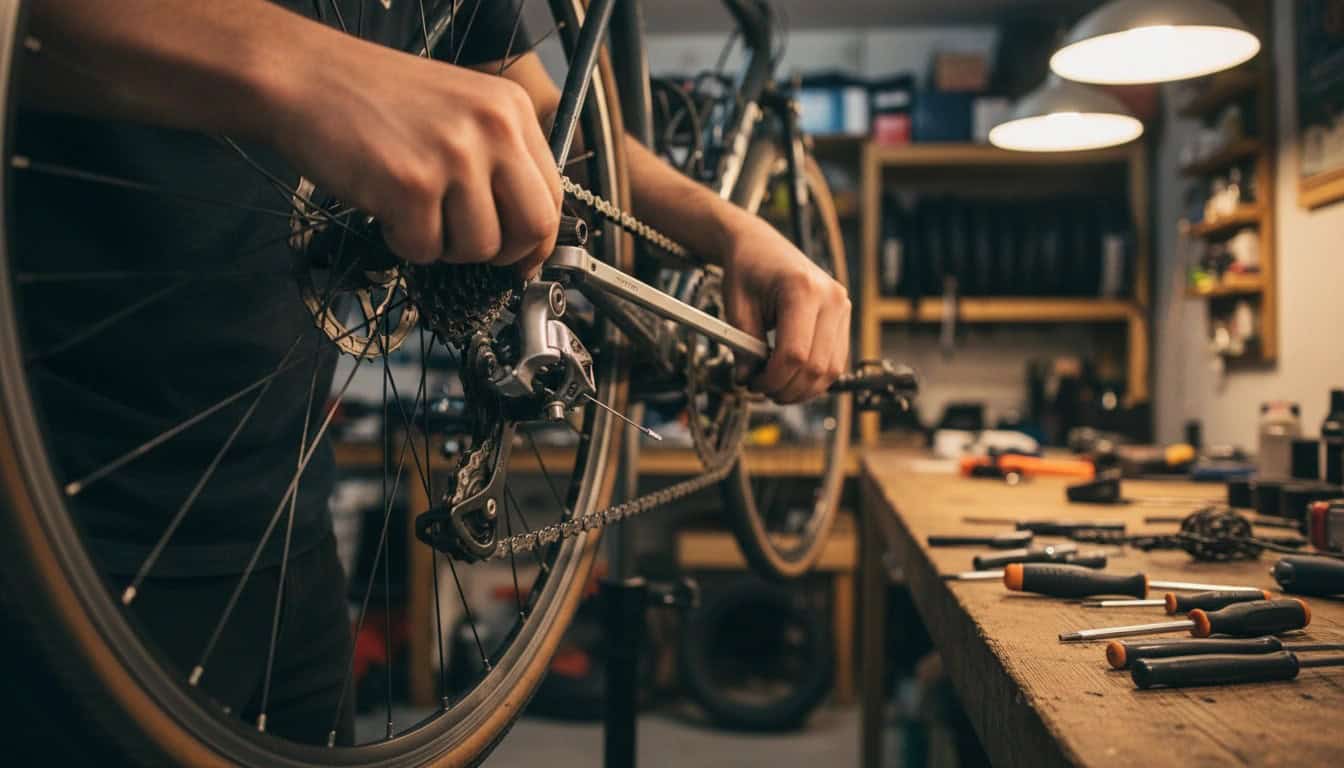
A loose chain on a derailleur bike is one of those things that starts as an annoyance and quickly turns into a real problem. It skips under load, drops off the chainring at the worst moment, and makes every pedal stroke feel a little uncertain. The good news is that on most derailleur bikes, you can sort this out without taking the wheel off or spending money at a shop.
Chains stretch over time – that’s just normal wear. Every pedal stroke puts load on the links, and after a few hundred miles the chain gets longer. Your derailleur’s rear spring absorbs most of that slack automatically, but once the chain wears past a certain point, the derailleur can’t compensate anymore. That’s when the slack becomes noticeable and the shifting starts to suffer.
This guide walks you through the whole fix, step by step, for a bike with a derailleur. If you have a single-speed bike, the process is completely different – I’ll point you to the right guide at the end of this section.
Tools You’ll Need
You don’t need much for this job. Most of it you probably already have.
- Chain checker tool (highly recommended – tells you if the chain is worn past the point of adjusting)
- Chain breaker / chain tool
- Quick link or master link (if removing chain links)
- Needle-nose pliers (for quick links)
- Hex key set (for cable tension adjustments on some bikes)
- Clean rag
- Chain lube
If you’re building out a basic repair kit, check out this list of essential bicycle repair tools – it covers everything you need for home maintenance without overcomplicating it. A good cycling multi-tool will also cover most of these in a single compact kit if you’re short on space.
How to Tell if Your Bike Chain Is Too Loose
Before you pull anything apart, confirm that a loose chain is actually your problem. A few other issues can cause similar symptoms – worn cassette teeth, a bent derailleur hanger, cable stretch – and diagnosing correctly saves you time.
Here are the main signs to look for:
| Symptom | What It Suggests |
|---|---|
| Chain skips or jumps under hard pedaling | Chain slack or worn chain/cassette |
| Chain drops off chainring or cassette | Excessive slack, derailleur limit issue, or bent hanger |
| Noisy, clunky shifting | Cable tension off, or chain wear |
| Chain slaps the chainstay (frame) | Too much slack in the drivetrain |
| Visible sag in the lower run of chain | Chain is longer than the derailleur can take up |
Quick physical check: with the bike in the smallest chainring and smallest sprocket (least chain demand), look at the rear derailleur. The two derailleur pulleys and the chain should form a fairly tight, slightly curved line. If the lower section of chain looks saggy, or the derailleur cage is pointing almost straight down instead of slightly angled back – that’s a sign you’ve got more slack than the system can handle.
You can also grab the chain at the chainring and try to pull it away from the teeth. A small amount of movement is fine. If you can pull it more than about half the tooth depth, the chain is worn or the system is running too loose.
How to Tighten a Bike Chain With a Derailleur
Here’s the thing about derailleur bikes: you don’t adjust chain tension the same way you would on a single-speed. The rear derailleur spring handles tension automatically. So “tightening” a chain on a derailleur bike actually means removing excess chain links – shortening the chain until the derailleur can properly manage the slack again.
Step 1: Check Chain Wear First
This is the most important step and most people skip it. Use a chain checker tool and measure the chain before doing anything else. If the chain is worn past its limit (0.5% on 11/12-speed, 0.75% on 10-speed and below), shortening it won’t actually fix your problem – you’ll need to replace the chain, and possibly the cassette too.
If you don’t have a chain checker, you can do the ruler method: place a ruler next to the chain with a pin sitting at the 0″ mark. At 12″, a new chain’s pin will sit exactly at 12″. If it sits past 12 and 1/16″, your chain is worn. Past 12 and 1/8″ means it’s really worn. Replace, don’t shorten.
Step 2: Shift to the Smallest Sprocket and Smallest Chainring
Before touching the chain, shift the bike into the gear that puts the least demand on chain length: the smallest rear sprocket and the smallest front chainring. This gives the derailleur the most slack to work with and makes it easier to assess what you’re dealing with.
Spin the pedals by hand and watch the rear derailleur. Note where the derailleur cage angle sits. You’ll use this as your reference after removing links.
Step 3: Identify Where to Break the Chain
Count out how many links you want to remove. Start with removing two links at a time (one inner, one outer link – they come in pairs). More than that and you risk making the chain too short for your largest sprocket combination.
Find a good spot on the chain to break it – ideally near the master link if your chain has one. If you’re not sure whether your chain has a master link, look for a link that looks slightly different from the others, usually with a notch or a different-colored plate.
Step 4: Break the Chain
If your chain has a master link, use needle-nose pliers to squeeze the two plates together and push the link sideways to release it. This is the easy way.
If there’s no master link, you’ll use a chain breaker tool. Place the chain in the tool’s slot and press the pin out just far enough to release the chain – don’t push the pin all the way out or it becomes very hard to reconnect. Leave the pin sitting just proud of the outer plate.
Step 5: Remove the Links
Remove the links you counted out. Remember: you always remove in pairs (one inner + one outer link) to keep the chain ending in the right configuration for reconnection. Set the removed links aside – don’t throw them out until you’ve confirmed the length is right.
Step 6: Reconnect the Chain
Reconnect using a new master link (most shops sell these for a dollar or two, and they’re much easier to work with than pushing pins back through). Thread the chain back through the drivetrain, making sure it runs correctly through the rear derailleur – over the top jockey wheel and under the bottom jockey wheel.
Snap the master link together by placing each half in the chain ends and pulling the chain taut until it clicks into place. Give it a tug to confirm it’s seated.
Step 7: Test the Chain Tension and Shifting
Spin the pedals by hand and run through all your gears. Pay attention to how the derailleur cage sits – it should now show a clear angle back (not pointing straight down), and there should be no visible sag in the lower chain run.
Test in the largest chainring and largest sprocket too – if the chain feels tight or the derailleur is being pulled past its range, you’ve gone too short. In that case, you’ll need to add links back (which means a new chain if you can’t source matching links).
Apply fresh chain lube after reconnecting – the chain goes through some stress during this process. A good chain lubricant guide can help you pick the right lube for your riding conditions.
Single Speed vs Derailleur: Different Process
If you have a single-speed bike or a fixie, stop here – this guide doesn’t apply to you. Single-speed bikes tighten the chain by moving the rear wheel backward in the dropout, which changes the distance between the axle and the bottom bracket. It’s a completely different adjustment.
Head over to the guide on how to tighten a bike chain on a single-speed bike for the correct process. Using the derailleur method on a single-speed (or vice versa) won’t work and can cause damage.
How to Prevent Chain Slack
Once you’ve got the chain sorted, a bit of routine maintenance keeps it from getting back to this point too fast.
Lube regularly. A dry chain wears faster. You don’t need to soak it – a light application of the right lube after wet rides or every 100-150 miles is enough. Wipe off the excess so it doesn’t attract dirt.
Check chain wear every few months. A chain checker takes about 30 seconds to use. Catching wear early means you replace the chain before it eats into your cassette – and cassettes cost a lot more than chains.
Keep the drivetrain clean. Grit and grime accelerate wear on every contact point. A quick wipe-down of the chain and jockey wheels after muddy rides makes a real difference over time.
Avoid cross-chaining. Running big-big or small-small gear combinations puts the chain at an angle and increases wear on both the chain and cassette. It also makes noise, which is your bike telling you to shift.
Match your replacement chain to your drivetrain. An 11-speed chain on a 10-speed cassette, or vice versa, will cause premature wear and poor shifting. Always match chain speed to your groupset. If you’re on a Shimano Claris or similar entry-level groupset, the spec is usually printed on the derailleur or in the manual.
When to Replace Instead of Tighten
Shortening a worn chain is like putting new tires on a car that needs new brakes – it fixes one symptom but doesn’t address the real problem. Here’s how to know when replacement is the right call.
Chain wear past 0.5% (11/12-speed) or 0.75% (10-speed and below). At this point, the chain has stretched enough that it no longer meshes properly with the cassette teeth. Shortening it won’t fix the skip – the geometry is off. Replace the chain.
Chain wear past 1.0%. If you’ve let it go this far, the cassette is likely worn too. A new chain on a worn cassette will skip constantly. You’ll probably need to replace both together.
The chain has been shortened multiple times. Every shortening reduces the length available for the derailleur to manage. Eventually there aren’t enough links left to accommodate your largest gear combination. At that point, the chain is done.
Bent or cracked links. If you spot any damaged links during this process, replace the chain. A failed link mid-ride can cause a crash.
Rust or stiff links that don’t free up. Light surface rust can sometimes be cleaned off. But if links are stiff and won’t flex after cleaning and lubing, the chain is past its useful life.
For a broader overview of how different Shimano groupsets handle chain wear and replacement intervals, the Shimano groupset comparison guide has useful context, especially if you’re deciding whether to upgrade the drivetrain at the same time.
Frequently Asked Questions
Can you tighten a bike chain with a derailleur without removing links?
Not really, no. The rear derailleur’s spring automatically adjusts tension within a certain range. If your chain has enough slack that you can see it sagging or it’s skipping, the derailleur has already reached its limit. The only real fix is to shorten the chain by removing links. There’s no bolt to turn or adjustment that adds tension the way there is on a single-speed bike.
How many links should I remove from a loose chain?
Start by removing two links – one inner and one outer link, which come as a pair. After reconnecting, test the shifting through all your gears. If there’s still noticeable sag, remove another pair. Don’t rush this – going too short means the chain can’t reach your largest rear sprocket and largest chainring without putting dangerous tension on the derailleur.
Why does my chain keep getting loose after I fix it?
If the chain keeps going slack after you’ve shortened it, the chain is probably worn. A stretched chain will continue to “stretch” further (it’s actually the pins wearing into the links) and no amount of shortening will fix underlying wear. Use a chain checker to measure wear. If it’s past 0.5% on 11/12-speed or 0.75% on 10-speed and below, replace the chain. Also check the cassette teeth – if they’re hooked or shark-fin shaped, the cassette needs replacing too.
Is it safe to ride with a loose chain?
It’s not dangerous in the same way as, say, a loose brake cable – but it’s not something to ignore either. A chain that drops while you’re pedaling hard can cause you to lose balance. It also causes accelerated wear on the cassette and chainring, and each skip puts extra stress on the chain links. Sort it out before your next ride if you can.
How often should I check my bike chain for wear?
If you’re riding regularly – say, a few times a week – check chain wear every two to three months. A chain checker tool costs around $10 and takes 30 seconds to use. Replacing a chain at the right time (before it hits 0.5% wear on 11/12-speed, or 0.75% on 10-speed and below) is the single best thing you can do for drivetrain longevity. Cassettes cost $30-$150 depending on the groupset. Chains cost $15-$40. The math is pretty clear.
🚲 Free: The Smart Bike Buyer’s Cheat Sheet
Get our 2-page PDF - budget tiers, the components that actually matter, and a 12-point used-bike inspection. We'll email you the download link. No spam, unsubscribe anytime.
By subscribing you agree to our Privacy Policy.
