
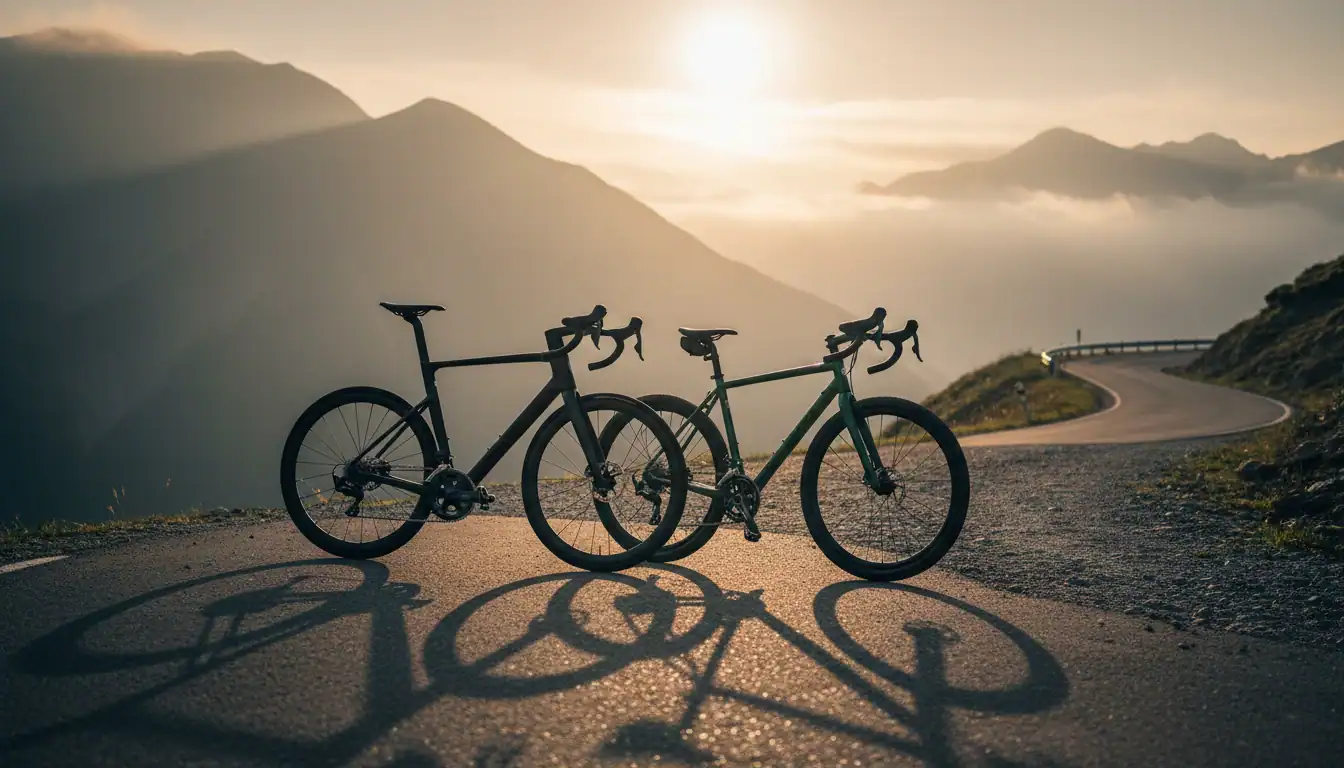
You have narrowed it down to two types: gravel bike or road bike. Both look similar at first glance. Both have drop handlebars. Both are built for speed and distance. But they are designed for fundamentally different purposes, and picking the wrong one will leave you frustrated every time you ride.
This guide breaks down the actual differences – not just specs on paper, but what they mean when you are out on a ride – so you can choose the right bike for the riding you actually do. (Still deciding between more than these two types? Our bike finder quiz covers the full range.)
Quick Answer: Gravel Bike vs Road Bike at a Glance
| Feature | Gravel Bike | Road Bike |
|---|---|---|
| Terrain | Paved roads + gravel, dirt, light trail | Paved roads only |
| Tire clearance | 35-50mm+ (wide, often knobby) | 23-32mm (narrow, slick) |
| Geometry | Relaxed, longer wheelbase | Aggressive, shorter wheelbase |
| Speed on asphalt | Slightly slower (wider tires, more resistance) | Faster (narrow tires, efficient position) |
| Comfort | Higher (more tire volume, upright position) | Lower (aggressive position, stiffer ride) |
| Versatility | High – one bike for multiple surfaces | Low – optimized for road only |
| Price range | $700-$5,000+ | $500-$10,000+ |
| Best for | Beginners, adventurers, mixed-surface riders | Racing, club rides, pure road performance |
What is a Gravel Bike?
A gravel bike is designed to handle multiple surfaces. It looks like a road bike with drop handlebars, but the frame geometry, tire clearance, and component choices are all tuned for versatility rather than outright speed on pavement.
The defining characteristics of a gravel bike:
- Tire clearance of 35-50mm or more – allows wide, high-volume tires that absorb trail vibration and handle loose surfaces
- Flared drop handlebars – the drops flare outward (typically 12-20 degrees) to give a wider, more stable grip position on rough terrain
- Relaxed geometry – longer wheelbase, higher stack height, less aggressive rider position. More comfortable over long distances and rough terrain, less twitchy at low speed
- 1x drivetrain option – many gravel bikes use a single chainring up front (no front derailleur) for simplicity and mud-shedding ability, paired with a wide-range cassette
- Mounts for bags, fenders, and racks – most gravel bikes include multiple bottle cage mounts, frame bag mounts, and often rack/fender eyelets for bikepacking or touring
What is a Road Bike?
A road bike is engineered for maximum efficiency on smooth, paved surfaces. The geometry is aggressive: low front end, high rear, to put the rider in an aerodynamic position. Every design decision trades comfort and versatility for speed and efficiency on tarmac.
- Tire clearance of 23-32mm – narrow tires have lower rolling resistance on smooth pavement. Modern endurance road bikes stretch to 32-35mm for comfort on rough roads
- Compact drop handlebars – narrower than gravel bars, parallel drops for an aerodynamic position
- Aggressive geometry – short wheelbase, lower stack, longer reach. Puts more power into the pedals but is harder on the back and wrists on long rides
- 2x drivetrain – double chainring with a close-ratio cassette gives fine-grained gear selection for road racing and climbing
- Minimal mounts – typically two bottle cage mounts. No rack or fender eyelets (with some endurance bike exceptions)
Gravel Bike vs Road Bike: Head-to-Head
Speed on Pavement
Road bikes are faster on smooth asphalt – typically 1-3 km/h at the same effort level. The main reasons: narrower tires with less rolling resistance, and a more aerodynamic rider position. In a group ride or race, that difference matters.
On rougher roads, the gap narrows significantly. A gravel bike running 38-40mm tires at lower pressure can actually roll faster than a road bike on chip seal or frost-damaged pavement, because the tire absorbs vibrations that would otherwise slow a stiff narrow tire down.
Comfort Over Distance
Gravel bikes are substantially more comfortable on long rides. The three main reasons: more tire volume absorbs road buzz, the geometry keeps you more upright, and the longer wheelbase dampens handling inputs. If you are planning rides of 80km or more, especially on mixed surfaces, the gravel bike wins comfortably.
Road bikes sacrifice comfort for performance. For riders training specifically for road racing or time trials, the aggressive position becomes second nature. But for most recreational riders, an hour on a road bike in the drops leaves the back and hands aching.
Versatility and Terrain
This is where gravel bikes have an undeniable advantage. A gravel bike can handle a morning road ride and an afternoon on packed gravel trails without changing anything. Swap to wider, knobby tires (on tubeless-ready wheels) and you can run light singletrack too.
A road bike on gravel is uncomfortable at best and dangerous at worst. 25mm tires on gravel puncture easily, wash out on corners, and transmit every vibration straight to your hands. Road bikes belong on roads.
Price Comparison
| Budget | Gravel Bike Options | Road Bike Options |
|---|---|---|
| Under $700 | Basic alloy, Claris/Sora, mechanical disc | Entry alloy, Claris/Sora, rim or disc |
| $700-$1,500 | Good alloy or entry carbon, Tiagra/105, 1x option | Good alloy, 105 disc, competitive |
| $1,500-$3,000 | Carbon, 105 or Ultegra, tubeless-ready | Carbon frame, Ultegra, race-ready |
| $3,000+ | High-end carbon, SRAM Force/Red AXS, full tubeless | Race-spec, Dura-Ace, aero frames |
At most price points, gravel bikes and road bikes are similarly priced. The premium at the top end goes to road bikes – race-spec aero frames and electronic groupsets push prices higher than comparable gravel builds.
Which Should You Choose? (4 Decision Scenarios)
Choose a gravel bike if:
- You want one bike for multiple surfaces. You ride roads during the week and want to explore gravel paths, forest roads, or canal towpaths on weekends. A gravel bike handles all of it.
- You are a new drop-bar rider. The relaxed geometry is more forgiving to learn on, and the wider tires are more stable and less prone to pinch flats while you build confidence.
- You want to do bikepacking or multi-day rides. Gravel bikes have the mounts for bags and racks, and the comfort geometry for days in the saddle.
- You mostly ride on rough or chip-sealed roads. Even if you never leave the pavement, gravel bike tires at lower pressure are more comfortable and can be faster than narrow road bike tires on poor surfaces.
Choose a road bike if:
- You want to race or ride in competitive sportives. Road bikes are faster, period. If speed and performance on tarmac is the goal, the road bike is the right tool.
- You ride exclusively on smooth paved roads. If you know you will never take the bike off-road, there is no reason to carry the extra weight and rolling resistance of a gravel bike.
- You ride in a group that sets the pace on road bikes. Being the rider on a gravel bike in a fast road group is hard work. Match your bike to your riding companions.
- You prioritize riding weight. Comparable road bikes are lighter than gravel bikes at every price point. If you are climbing and every gram matters, road wins.
Can You Convert a Road Bike to Gravel?
Partially, but with limits. The main constraint is tire clearance. Most road bikes have clearance for no more than 28-32mm tires. You cannot physically fit 40mm gravel tires on a frame designed for 25mm. Even if you stretch the clearance to 32mm, you lose the main benefit of a gravel bike – the wide, volume-rich tires that absorb rough surfaces.
What you can do: run the widest tire your road frame allows, swap to more comfortable handlebars (ergonomic drops), and add a frame bag or saddle bag for light touring. This turns a road bike into a capable endurance road bike – but it will not turn it into a gravel bike. The geometry remains aggressive, the tire clearance stays limited.
If you want a versatile bike and already own a road bike, the better option is often to buy a second-hand gravel bike rather than trying to convert what you have.
Recommended Gravel Bikes
Looking for specific models? Check our best gravel bikes under $500 for solid entry-level options. For a broader overview of bike categories, see our guide to types of bikes.
If you are leaning toward a road bike on a budget, the Shimano Claris groupset is what you will find on most entry-level road bikes under $800 – read our breakdown to know what you are getting. For bikes in that range, our best road bikes under $300 and best road bikes under $1,000 guides have you covered.
Frequently Asked Questions
Is a gravel bike faster than a road bike?
On smooth pavement, a road bike is faster – typically by 1-3 km/h at the same effort level due to narrower tires and a more aerodynamic position. On rough or mixed surfaces, the gap narrows considerably and a gravel bike can match or beat a road bike.
Can a gravel bike replace a road bike?
For most recreational cyclists, yes. A gravel bike covers 90% of what a road bike can do on pavement, while adding off-road capability. It is only in race-specific or fast group ride scenarios that the road bike’s performance advantage becomes decisive.
Can I use a gravel bike for commuting?
Gravel bikes are excellent commuters. The wide tires handle rough city roads and potholes, the geometry is more comfortable for stop-start riding, and the mounting options allow racks for bags. Many commuters prefer a gravel bike over a road bike for exactly these reasons.
What is gravel bike speed vs road bike?
In real-world riding, expect a gravel bike to average roughly 2-3 km/h slower than a road bike on the same smooth roads at the same effort. Over 60-100km rides on mixed surfaces, the gap often closes because the gravel bike’s comfort allows you to sustain effort for longer without fatigue.
Do gravel bikes have gears?
Yes – gravel bikes use standard gear systems. Most entry to mid-range gravel bikes use a 2x drivetrain (two chainrings up front) similar to road bikes, giving 18 or 20 speeds. Many performance gravel bikes use a 1x drivetrain (single chainring) with a wide-range cassette for simplicity and mud-shedding.
🚲 Free: The Smart Bike Buyer’s Cheat Sheet
Get our 2-page PDF - budget tiers, the components that actually matter, and a 12-point used-bike inspection. We'll email you the download link. No spam, unsubscribe anytime.
By subscribing you agree to our Privacy Policy.