
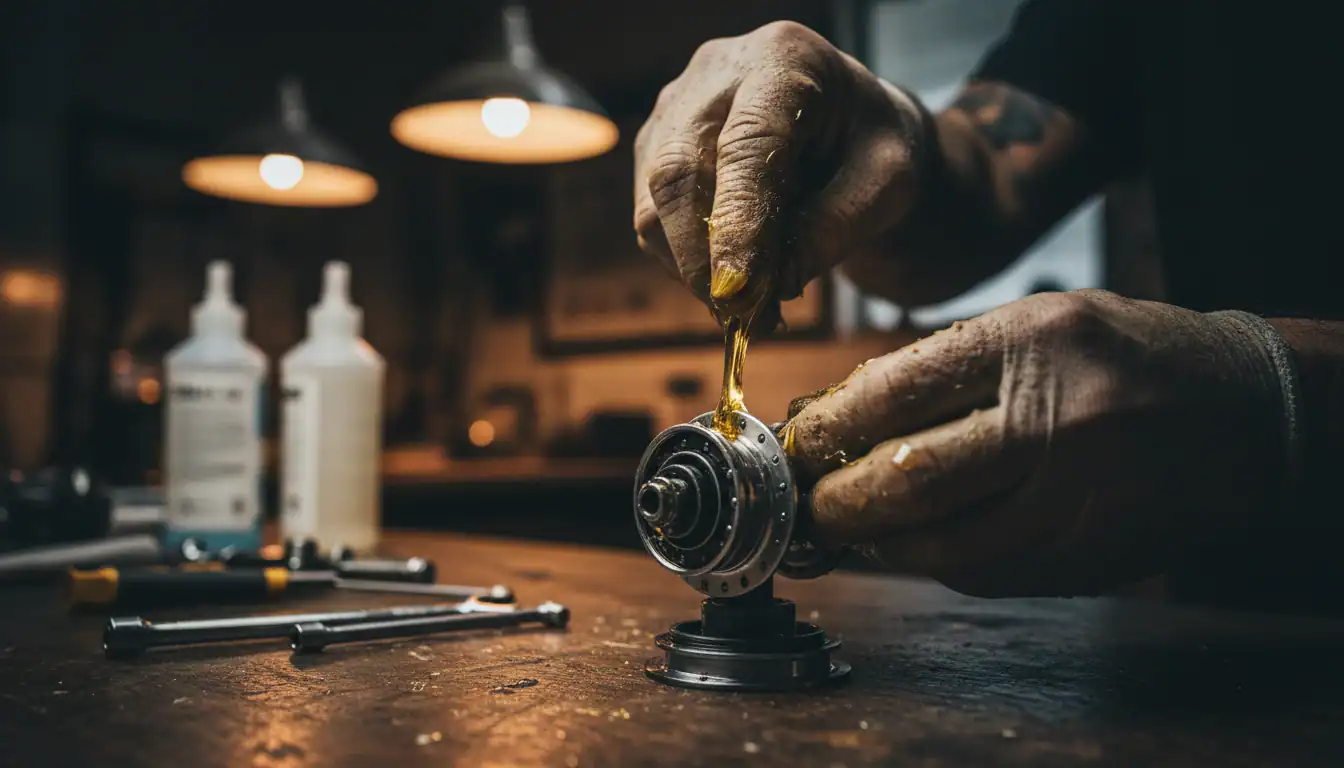
Most cyclists know they need to lube their chain. Far fewer know that the wrong grease — or no grease at all — is quietly destroying their bearings, seizing their bottom bracket, and creaking their headset into an early grave. After testing bikes in all conditions and tearing down more hubs than we’d care to count, we put together the definitive guide to bicycle grease: what it is, where it goes, and exactly how to apply it.
🔧 Tools & parts you’ll need
These are the products we actually reach for when greasing a bike. As an Amazon Associate we earn from qualifying purchases, at no extra cost to you.
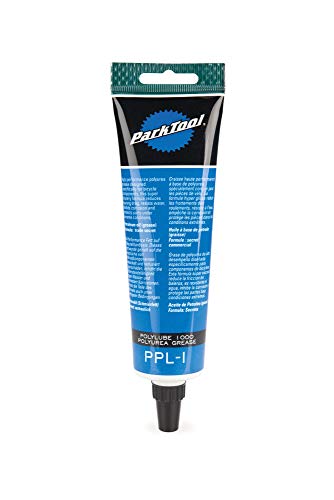 Park Tool PPL-1 PolyLube 1000 Grease
all-purpose grease for bearings, threads, and seatposts.
VIEW LATEST PRICE Finish Line Premium Bike Grease
water-resistant grease for hubs and bottom brackets.
VIEW LATEST PRICE

Which Grease Goes Where: Quick Reference Table
Before anything else, here’s the table you actually need. Bookmark this — it covers every component on your bike and exactly what to use.
| Component | What to Use | How Much | How Often |
|---|---|---|---|
| Bottom bracket threads | Grease or anti-seize | Thin, even coat on all threads | At installation; re-check every 2 years |
| Headset bearings (cup-and-cone) | Grease | Pack bearing races fully | Every 1–2 years (more in wet/muddy conditions) |
| Headset bearings (sealed cartridge) | Replace when worn; experienced mechanics may repack after popping the seal | — | Replace if notchy or loose |
| Hub bearings (cup-and-cone) | Grease | Pack cone and bearing cup fully | Every 1–2 years or ~5,000 miles |
| Hub bearings (sealed cartridge) | Replace when worn; experienced mechanics may repack after popping the seal | — | Replace if rough or loose |
| Pedal threads (metal frame) | Grease | Thin coat on pedal spindle threads | At every installation |
| Pedal threads (carbon frame) | Anti-seize compound | Thin coat | At every installation |
| Seatpost (metal-on-metal) | Grease or anti-seize | Thin coat on insertion area | Every 6–12 months if removed |
| Seatpost (carbon frame or carbon post) | Carbon assembly paste (friction compound) | Thin coat | Every 6–12 months or per spec |
| Stem clamp bolts | Anti-seize or light grease | Trace on threads only | At installation; annual check |
| Derailleur pivot bolts | Light grease | Minimal — thread coverage only | Annual |
| Brake caliper bolts | Light grease on threads only | Minimal | Annual |
| Freehub body threads | Grease or anti-seize | Thin coat | When removing freehub |
| Chain | Chain lube — NOT grease | One drop per link, wipe excess | Every 100–200 miles |
| Cable housing / inner wires | Cable-specific lube | Internal only | Annual or when shifting feels sluggish |
Grease vs. Chain Lube vs. Anti-Seize: What’s the Difference?
This is the most common point of confusion among cyclists: using the wrong product for the job. Grease, chain lube, and anti-seize compound each do a specific job — and substituting one for another causes real damage over time.
| Product | Consistency | Best for | Never use on |
|---|---|---|---|
| Bicycle grease | Thick (NLGI 2 — like soft butter or shortening) | Bearings, hub races, headset, cup-and-cone hubs | Chain, cables, brake pads, carbon-on-carbon interfaces |
| Anti-seize compound | Thick paste with metallic particles | Threaded bolts, pedal spindles on carbon frames, seatposts prone to seizing | Bearing races, chain |
| Chain lube (wet/dry) | Thin liquid or wax | Chain, brake lever pivots, derailleur jockey wheels | Bearings, threaded interfaces |
| Carbon assembly paste | Thick paste with grit filler | Carbon-on-carbon or carbon-on-aluminum contact areas | Metal bearings, chains |
A quick rule of thumb that holds up in practice: if it’s a threaded interface or a bearing, use grease or anti-seize. If it moves repeatedly (chain, cables, pivots), use lube. Never the other way around. Grease on a chain attracts so much grit it’ll wear out your chainring and cassette in a season. And thin lube in a cup-and-cone hub washes out within a few rides, leaving bare metal grinding on bare metal.
For a full breakdown of chain lubrication options, see our bicycle chain lube guide. If you work with hydraulic disc brakes, note that brake fluid is a completely separate category – see our brake fluid guide for that. Disc brake pad condition is worth checking at the same service interval – our disc brake pads guide covers when to replace and what to look for.
Signs Your Bike Needs Re-Greasing
A good benchmark for re-greasing cup-and-cone hubs and headsets is every 1–2 years of regular riding, or sooner if you ride in wet or muddy conditions. But grease doesn’t always fail on a schedule — here’s how to recognize it early.
| Cause of Grease Failure | What You’ll Notice |
|---|---|
| Age / infrequent use | Hardened grease around threaded parts; bearing feels stiff when cold |
| Metal particle contamination | Light-colored grease has turned dark; bearing feels notchy or rough |
| Moisture contamination | Reddish rust color in grease; rust on bearing parts; water droplets visible |
| Dirt contamination | Gritty, sandy feeling in the bearing; distinct from simple bearing tightness |
| Wrong grease type | Grease has washed out completely after wet rides (too thin); or grease cracked and separated (low-quality product) |
Sealed vs. Cup-and-Cone Bearings: Does It Change What You Do?
Yes — significantly. This is the part most guides skip over, and it trips up a lot of people.
Cup-and-cone bearings (found on most Shimano hubs and many older bikes) use loose ball bearings running on adjustable cone-shaped races. These are designed to be serviced: you open them up, clean the old grease, inspect the bearing surfaces, and repack with fresh grease. You should do this every 1–2 years.
Sealed cartridge bearings (found on most modern mountain bikes, road bikes with higher-end hubs, and most headsets) are self-contained units. They are not designed to be repacked — attempting to force grease into a sealed cartridge bearing is likely to do more harm than good. When they feel rough or develop play, you replace the entire cartridge. Some experienced mechanics do pop seals and repack cartridge bearings, but for most riders it’s not worth the effort.
How to tell which you have: Look at your rear hub. If you can see an adjusting cone nut on the axle that you can turn with a cone wrench, it’s cup-and-cone. If the axle has a smooth, non-adjustable end cap, it’s sealed cartridge.
What Kind of Grease to Use
The honest answer: most NLGI Grade 2 bearing greases work well on bikes. The “bicycle grease” label is largely a marketing distinction. That said, there are situations where the specific formulation matters.
Carbon fiber frames and components: Petroleum/Teflon-based greases can degrade carbon fiber over time. If your bike has a carbon frame, carbon seatpost, or carbon handlebar/stem, use a grease explicitly marked as carbon-safe — Park Tool PolyLube, White Lightning Crystal, or Phil Wood Waterproof are all carbon-safe options. Alternatively, use carbon assembly paste on any carbon-on-carbon or carbon-on-aluminum interfaces.
Ceramic bearings: Standard lithium-based grease is generally fine for ceramic bearings. The bigger concern is avoiding abrasive particles — so don’t use anti-seize compounds near ceramic bearing surfaces.
Wet/muddy riding: Heavier waterproof greases (Phil Wood, Shimano Dura-Ace) stay put better in wet conditions. Lighter, thinner greases wash out faster.
Budget option: Mobil XHP222 or similar NLGI 2 automotive bearing grease works well and costs a fraction of branded bike greases. Many experienced mechanics use it without issue. The trade-off is that you don’t get carbon-safe certification or specific marketing claims.
How to Apply Bicycle Grease: Step by Step
The application process is the same whether you’re greasing pedal threads or packing a hub. Here’s what it looks like in practice.
Our Pick
Having the right tools makes bearing and drivetrain service dramatically faster. A quality cycling multi-tool gives you hex keys, screwdrivers, and chain tools in one compact kit – enough to handle most of what this guide covers.
See our top picks →- Gather your tools. You’ll need: the right grease for the job, clean rags, isopropyl alcohol (91%+ works best), and the tools to access the component (pedal wrench, cone wrench, bearing press, etc.). A good cycling multi-tool covers most of the hex keys and screwdrivers needed for bolted interfaces.
- Disassemble and access the component. For threaded interfaces, simply remove the bolt or component. For cup-and-cone hubs, remove the wheel, then carefully undo the locknut and cone to expose the bearing cup and balls.
- Clean out old grease. Use a rag and isopropyl alcohol to remove all old grease from the bearing surface, threads, or interface. Old and new greases can be incompatible — and dirty, degraded grease accelerates wear. On threads, a small brush helps get into the grooves.
- Inspect for wear. This is the step most people skip. Before applying new grease, look at the bearing surfaces. Pitting or scoring (small craters or grooves) means the cup or cone needs replacing — no amount of fresh grease will fix that. On ball bearings, check for flat spots or rough rolling.
- Apply grease. Threaded interfaces: a thin, even coat on all exposed threads — you should see the thread profile through the grease, not a thick glob. Cup-and-cone bearings: fill the bearing cup with enough grease that the ball bearings are fully embedded when you press them in. Sealed areas (e.g., seatpost): a thin smear on the insertion area only.
- Reassemble and torque correctly. Use a torque wrench on critical bolts. Common specs: bottom bracket shell = 35–50 Nm (check your specific BB); pedals = 35 Nm (left pedal is reverse-threaded); stem face plate bolts = 5–6 Nm; stem binder bolt = 12–15 Nm. Over-torquing greased threads is a common mistake — the grease reduces friction, meaning you reach the same clamping force at a lower torque reading than dry.
- Wipe away excess. Any grease that squeezes out should be removed with a clean rag. Excess grease on the outside of components acts as a dirt magnet and can migrate onto brake rotors or pads — which will destroy braking performance.
How Often to Grease Your Bike: Maintenance Schedule
| Component | Interval | Notes |
|---|---|---|
| Cup-and-cone wheel hubs | Every 1–2 years or ~5,000 miles | More often if riding in wet or muddy conditions regularly |
| Bottom bracket (threaded) | Every 2 years; inspect annually | Creaking from the BB area often means it needs re-greasing |
| Headset | Every 1–2 years | Off-road riders: every season |
| Pedal threads | Every time you remove and reinstall pedals | Always grease before installation; prevents seizing |
| Seatpost | Every 6–12 months, or when removed | Don’t remove the seatpost unnecessarily — each removal risks scratching the seating area |
| Stem bolts / clamp bolts | Annual; when reassembling after crash or fit adjustment | Use anti-seize on titanium and carbon interfaces |
| Freehub body | When removing for service or cassette swap | Light grease on freehub threads prevents seizing onto the hub shell |
Riding through winter? Slush and road salt wash grease out faster, so check hubs and headset more often. Our winter cycling gear guide covers wet lube, fenders and salt cleanup.
Best Bicycle Greases Available on the Market Today
Here’s a quick comparison of the greases we recommend, followed by a closer look at each one.
| Grease | Best for | Carbon safe? | Approx. price |
|---|---|---|---|
| Finish Line Premium | Wet conditions, all-around bearing use | No (too slippery for carbon interfaces — overtorque risk) | ~$9 |
| Park Tool PolyLube 1000 | All-around use, shop/home maintenance | Yes | ~$12 |
| White Lightning Crystal | Eco-conscious riders, clear visibility | Yes | ~$8 |
| Phil Wood Waterproof | Long-lasting, waterproof applications | Yes | ~$12 |
| Bel-Ray Waterproof | Budget-friendly, volume use | Check label | ~$6 |
| Shimano Dura-Ace | Shimano hub and BB service | Yes | ~$15 |
1. Finish Line Premium Grease
Finish Line Premium Grease is Teflon-based, which gives it good water resistance — it doesn’t wash out quickly even after wet rides. It works well for wheel bearings, headset service, and pedal threads. The Teflon particles improve its performance in high-load bearing applications. One limitation: it is not carbon-safe, so skip it if you have a carbon frame or carbon components. It also runs thicker than some greases, which makes precision application a little harder than with thinner formulations.
2. Park Tool PolyLube 1000 Grease
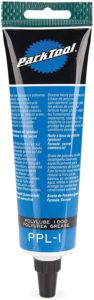
Park Tool PolyLube 1000 is the shop standard for a reason. It works on essentially every application: cup-and-cone hubs, headsets, bottom bracket threads, pedal threads. It’s carbon-safe and comes in both tube and jar form — the jar is worth it if you’re servicing multiple bikes. Slightly more expensive per ounce than generic greases, but the quality and versatility make it easy to recommend as a single “buy one, use everywhere” option for most home mechanics.
3. White Lightning Crystal Grease
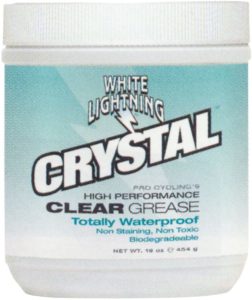
White Lightning Crystal Grease’s biggest practical advantage is that it’s clear. When you can see through the grease, you can spot rust or wear on the bearing surface without removing all the grease first — a genuinely useful feature when doing quick inspections. It’s carbon-safe, odorless, and performs well across standard applications. Marketed as biodegradable, though this claim has been questioned. For general bearing and thread work, it’s a solid, affordable choice.
4. Phil Wood Waterproof Grease
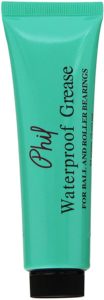
Phil Wood has a reputation among touring and commuting cyclists for a reason: it stays put. It’s a heavier grease that resists water washout well, making it a good choice for hub bearings on bikes that see a lot of wet weather riding. Carbon-safe, long-lasting, and the green tube has become iconic. The main downside is that it only comes in small tubes — if you’re servicing multiple bikes regularly, you’ll go through it faster than you’d like.
5. Bel-Ray Waterproof Grease
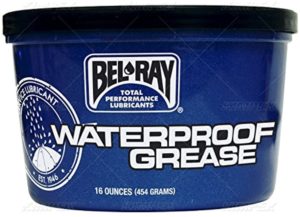
Bel-Ray is the best pure-value option on this list. The 16 oz tub gives you far more grease per dollar than any tube-format bike-specific product. It works well for general bearing and thread use. It’s marketed primarily for motorcycles, but the same NLGI 2 formulation makes it perfectly usable on bicycles — many experienced mechanics use it without issue. Not carbon-safe confirmed, so avoid it if you have carbon components. For a steel or aluminum bike with cup-and-cone hubs, it’s hard to argue against the value.
6. Shimano Dura-Ace Grease
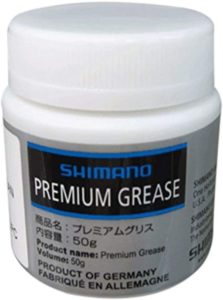
If you’re servicing Shimano cup-and-cone hubs, there’s a certain logic in using Shimano’s own grease — it’s what the hubs were designed around. Shimano Dura-Ace Grease is waterproof, long-lasting, and carbon-safe. It has excellent anti-corrosion properties, which matters particularly for axle and cone threads. The price is higher than most alternatives for what you get, and the container isn’t large. Worth it if you have multiple Shimano-hubbed bikes; otherwise, Park Tool PolyLube gives you essentially the same result at lower cost.
Frequently Asked Questions
Can I use WD-40 as bicycle grease?
No. WD-40 is a water-displacing solvent and light lubricant, not a grease. It evaporates quickly and leaves no protective film on bearing surfaces. Using it on bearings or threads will strip away any remaining grease, leaving bare metal. Use it only for freeing rusted bolts or cleaning components — then follow up with the correct grease or lube.
Can I use automotive grease on my bike?
Generally yes, for non-carbon bikes. Standard NLGI Grade 2 automotive bearing grease (like Mobil XHP222) works well on bicycle bearings and threads. The main limitations: not carbon-safe, and high-temperature formulations (designed for wheel bearings running at 200°F+) are overkill and sometimes too thick. For carbon frames or components, stick with a bicycle-specific grease that’s explicitly marked carbon-safe.
How much grease is too much?
On threaded interfaces, you should be able to see the thread profile through a thin grease layer — not a thick glob. On cup-and-cone bearings, the bearing cup should be filled enough that the ball bearings sit fully embedded in grease, but not so packed that grease squeezes out the bearing seal when you reassemble. Excess grease on threads can slightly reduce the torque needed to achieve proper clamping force — account for this if you’re torquing to spec.
What’s the best grease for a bike seatpost?
It depends on your frame and post material. Metal-on-metal (aluminum post in aluminum frame): use regular grease or anti-seize. Carbon post in carbon frame, or carbon post in aluminum frame: use carbon assembly paste (also called carbon grip paste or friction paste) — this prevents the seatpost from slipping without the seizing risk. Avoid standard grease on carbon-on-carbon interfaces; it reduces friction so much that you’d need to overtorque the clamp to prevent slipping, which risks cracking the carbon. For a deeper dive on valve maintenance, see our guide to removable Presta valve cores.
The Bottom Line
Bicycle grease is one of the most neglected parts of bike maintenance — and one of the cheapest ways to significantly extend the life of your components. The key takeaways: use grease on bearings and threads, anti-seize on carbon interfaces and prone-to-seize threaded parts, chain lube on your drivetrain, and never substitute one for the other.
For most riders with a non-carbon bike, Park Tool PolyLube 1000 or Phil Wood Waterproof is the right all-around choice. If you’re on a budget and servicing a steel or aluminum bike, Bel-Ray gives you excellent value. Carbon bike owners should stick to explicitly carbon-safe options and use carbon assembly paste on seatpost and stem interfaces.
Set a reminder to service your cup-and-cone hubs and headset once a year — it takes under an hour and you’ll feel the difference immediately.
🚲 Free: The Smart Bike Buyer’s Cheat Sheet
Get our 2-page PDF - budget tiers, the components that actually matter, and a 12-point used-bike inspection. We'll email you the download link. No spam, unsubscribe anytime.
By subscribing you agree to our Privacy Policy.

Why finish line teflon grease is not suitable for carbon frames?
Thanks for the valuable advice, Mr. Marco. 👍