
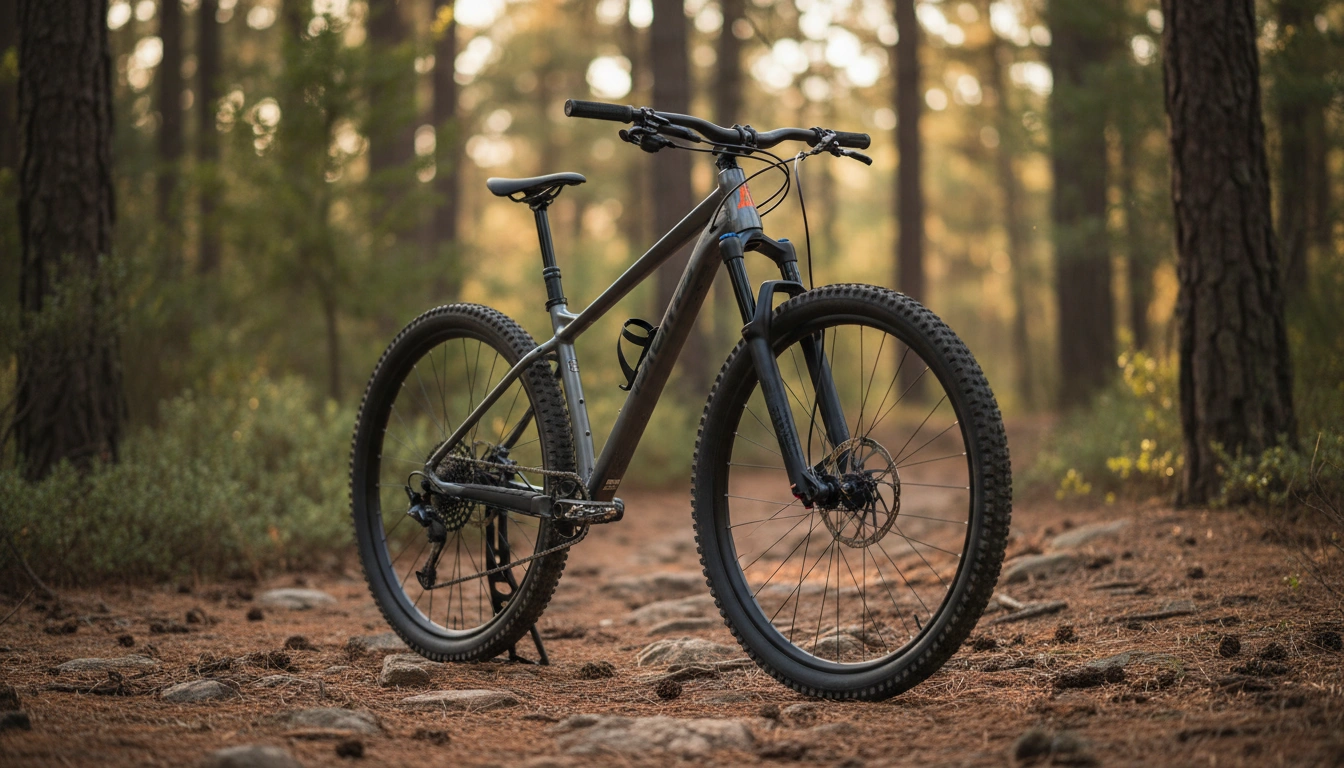
There’s a reason mountain biking has this hold on people that road cycling or gym workouts just can’t replicate. You’re out on actual dirt, reading the trail in front of you, making split-second decisions about your line, and occasionally eating it in the most spectacular way possible. The sense of freedom is real. The adrenaline is real. The mud on your face is definitely real. And unlike a lot of hobbies, the barrier to entry isn’t actually as high as the price tags on bike shop windows make it seem.
Whether you’re just getting started and have no idea what “29er” or “trail geometry” means, or you’ve been riding for a few years and want to upgrade from that heavy box-store bike to something that actually works on technical terrain – this hub has you covered. We’ve organized the entire mountain bike category by skill level, bike type, budget, and brand so you can find the exact angle that matches where you’re at right now.
Every linked article in this hub is a dedicated deep-dive – full roundups, real specs, and honest recommendations. Not sure what type of mountain bike fits you? Take our quick quiz to find out, or start with the section below that matches your situation.
Types of Mountain Bikes
Not all mountain bikes are built for the same trails – and this is where most first-time buyers get confused. Here’s the breakdown that actually matters.
Hardtail – Front suspension only (no rear shock). Lighter, less expensive, lower maintenance. Great for beginners, cross-country riding, and smoother trails. This is where most riders start, and honestly, where a lot of experienced riders stay – especially for climbs.
Full-Suspension – Front and rear suspension. Better comfort and control on technical, rocky, rooty terrain. You pay more and carry more weight, but the rear shock does a real job when the trail gets rough. Makes challenging terrain significantly more manageable.
Within those two categories, bikes are further divided by riding style:
- Cross-Country (XC) – Built for speed and efficiency. Light frames, shorter travel suspension (80-100mm), aggressive riding position. Designed to cover miles fast, not to handle big drops. If you race or ride mostly smooth singletrack, this is your category.
- Trail – The all-rounder of mountain biking. 120-140mm of suspension travel, relaxed-but-capable geometry, good climbing and descending balance. This is where most recreational riders land, and for good reason – it handles the widest variety of terrain well.
- Enduro – Built for aggressive descents with 140-170mm travel and slack geometry. Still capable of climbing (you need to get up the hill to come back down), but the priority is descending performance. For riders who want to push technical terrain hard.
- Downhill (DH) – Maximum travel (170-200mm), purpose-built for lift-served descents. Heavy, extremely capable on gnarly terrain, and completely impractical for anything involving actually pedaling uphill. Needs a bike park or chairlift to make sense.
- Fat Bike – Oversized tires (3.8-5 inches wide) for riding on snow, sand, mud, and loose terrain where regular mountain bike tires would sink and slide. Slower on hardpack, but genuinely useful in specific conditions.
Quick Picks: Top Mountain Bikes
If you want a starting point before reading the full category breakdowns, here are five picks that cover the most common mountain bike situations.
| Outroad 26″ Mountain Bike (7-Speed) |  |
Best Budget Beginner | Wheels: 26″ | Drivetrain: 7-speed twist shift | Brakes: V-brakes, lockout fork | VIEW LATEST PRICE | See Full Roundup |
| Mongoose Malus Fat Tire Mountain Bike |  |
Best for All-Terrain Grip | Tires: 26″ x 4″ knobby fat | Frame: Steel, 7-speed Shimano | Brakes: Front & rear disc | VIEW LATEST PRICE | See Full Roundup |
| WEIZE Hardtail Mountain Bike 29″ |  |
Best Mid-Range Hardtail | Frame: 6061 aluminum hardtail | Wheels: 29″ | Drivetrain: 21-speed trigger, suspension fork | VIEW LATEST PRICE | See Full Roundup |
| Schwinn Protocol Full Suspension MTB |  |
Best Budget Full-Suspension | Suspension: Aluminum full-suspension | Drivetrain: 21-speed | Brakes: Front & rear mechanical disc, 26″ | VIEW LATEST PRICE | See Full Roundup |
| Mongoose Impasse HD 29″ Mountain Bike | 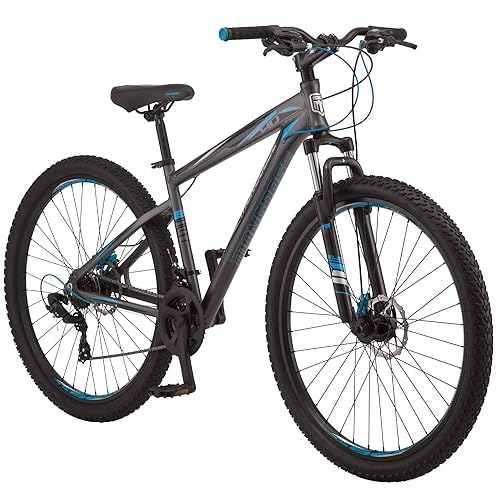 |
Best Under $700 | Frame: Aluminum | Tires: 29 x 2.6″ | Drivetrain: 21-speed SRAM trigger, disc brakes | VIEW LATEST PRICE | See Full Roundup |
These picks are a starting point, not the final word. If your situation is more specific – a certain trail type, skill level, or brand preference – use the sections below to find the right article.
Mountain Bikes by Skill Level
The biggest mistake first-time buyers make is buying a bike for the rider they think they’ll become, not the rider they are right now. Here’s how to match your bike to where you actually are.
- Complete beginner – You want something forgiving, reliable, and easy to maintain while you figure out what you actually like about riding. A hardtail with 100mm of travel and a 2x or 3x drivetrain does the job without the complexity or cost of full-suspension. Full roundup: Best Mountain Bikes for Beginners
- Budget-conscious rider – Whether you’re starting out or just don’t want to spend big before you’re sure about the hobby, there’s more choice under $700 than people expect. See what actually performs in that price range: Best Mountain Bikes Under $700
- Hardtail enthusiasts – Not everyone needs or wants full-suspension. Hardtails are faster on climbs, easier to maintain, and lighter – and a good hardtail at $600-800 will destroy a cheap full-suspension bike on almost any trail. Best picks across budgets: Best Hardtail Mountain Bikes
- Full-suspension curious – Wondering if the rear shock actually makes a difference? The Schwinn Protocol is a solid entry point for testing full-suspension without the full-suspension price. Full roundup: Best Mountain Bikes Under $700
- Brand-loyal riders – If you already know you want a Yeti or are considering Evil Bikes, we’ve gone deep on both. Yeti reviews: Best Yeti Mountain Bikes – Evil Bikes guide: Evil Mountain Bikes Buyer’s Guide
- Schwinn riders – Schwinn still makes solid budget mountain bikes that punch above their weight at the entry-level price point. What’s actually worth buying: Best Schwinn Mountain Bikes
- Haro bike curious – Haro has a loyal following but is less talked about than Trek or Specialized. Are they actually worth it? We looked into it: Are Haro Bikes Good?
- Need something different – The OYMA Power Bike is a mountain bike that actually folds up – which sounds like a party trick until you realize how useful it is for truck beds, car trunks, and tight storage. Full breakdown: OYMA Power Bike: Mountain Bike That Folds Up
- Gear and accessories – Once you have the bike, the right accessories make every ride better. Helmets, tools, pumps, protection gear – all the trail essentials in one place: Best Mountain Bike Accessories
Hardtail vs Full-Suspension: Which Should You Get?
This debate comes up constantly, and the answer is almost never “get full-suspension” – at least not as a blanket statement.
Get a hardtail if:
- You’re a beginner or intermediate rider on smooth to moderate trails
- You’re working with a budget under $1,000-1,200
- You do a lot of climbing and care about efficiency
- You want lower maintenance and fewer things to go wrong
- You ride mostly cross-country or trail terrain that doesn’t get seriously technical
Get full-suspension if:
- You’re riding technical terrain with roots, rocks, and drops regularly
- You’re willing to spend $1,500+ to get a rear shock that’s actually good (cheap full-suspension is often worse than a comparable hardtail)
- You want to push your riding harder without getting beaten up by the trail
- You ride enduro-style or descend aggressive terrain
The trap most people fall into is buying cheap full-suspension because it sounds more capable. At low price points, the rear shock is often poorly tuned, adds unnecessary weight, and flexes in the wrong places. A $600 hardtail from a decent brand will usually outperform a $600 full-suspension bike on almost any terrain. The full-suspension advantage kicks in when you’re spending enough to get a rear shock that actually works well.
Still deciding? Read the full comparison on hardtail geometry and what to expect from each: Best Hardtail Mountain Bikes
What to Look for in a Mountain Bike
Most buyers focus on the bike’s “look” or the brand name and completely miss the specs that actually determine ride quality. Here’s what to check before you buy.
Frame and Wheel Size
Mountain bikes come in three main wheel sizes: 26-inch (mostly older or budget bikes), 27.5-inch (more maneuverable, good for technical riding and shorter riders), and 29-inch (the current standard for XC and trail riding – rolls over obstacles better, faster on smooth terrain). Most trail bikes today are 29er or 27.5″, and most riders over 5’8″ will prefer 29″. (If you’re unsure about your frame size, our bike size calculator can help.) If you’re shorter or want more playful handling, 27.5″ is a legitimate choice.
Frame material matters too. Aluminum is the standard – light enough, stiff, and durable. Steel is heavier but absorbs vibration better and is cheaper to repair. Carbon fiber is lighter and stiffer but expensive and doesn’t absorb impacts well – not ideal for rocky terrain unless you’re riding a premium build.
Suspension Type and Travel
Suspension travel (measured in millimeters) tells you how much the fork and shock can compress. More travel handles bigger hits better but adds weight and changes geometry. General guidelines: 80-100mm for XC and smooth trails, 120-140mm for trail riding, 150-170mm for enduro, 180-200mm for downhill. Match your travel to your terrain – a 170mm enduro bike on a flat smooth trail is just extra weight you’re carrying around for no reason.
Drivetrain: Shimano and SRAM Hierarchy
Shimano is the most common drivetrain brand on mountain bikes. The hierarchy (lowest to highest quality) goes: Tourney/Altus – Acera – Alivio – Deore – SLX – XT – XTR. For real trail riding, Deore is the entry point for a reliable 1x or 2x drivetrain. SLX and XT are genuinely excellent and last for years. Anything below Deore on a mountain bike is budget territory.
SRAM’s equivalent hierarchy: SX – NX – GX – X01 – XX1. GX is roughly equivalent to XT and is popular with riders who want a good 1×12 setup. Eagle (GX Eagle, X01 Eagle) refers to their 12-speed 1x system, which has become the go-to for trail and enduro riders who want to simplify their drivetrain without losing range.
Brakes
Hydraulic disc brakes are the standard on any mountain bike worth riding on real trails. They offer more stopping power, better modulation, and less hand fatigue on long descents than mechanical disc brakes. Mechanical disc (cable-actuated) is acceptable on entry-level bikes, but if the bike you’re considering has rim brakes, that’s a dealbreaker for off-road use. Look for brand names like Shimano MT200, Tektro, or SRAM Level at the entry level – Shimano XT or SRAM Guide for serious riding.
Tire Tread and Width
Mountain bike tire tread matters a lot more than most buyers expect. Wider tires (2.4-2.6 inches) with aggressive knobs handle loose dirt, roots, and wet conditions far better than narrow tires with minimal tread. Many entry-level bikes ship with narrow, low-tread tires that limit trail performance significantly – an easy and relatively cheap upgrade. Maxxis Ardent, Maxxis Minion DHF/DHR, and Schwalbe Nobby Nic are reliable tire choices that come as upgrades on better builds.
Dropper Post
A dropper post lets you lower your saddle on the fly with a handlebar-mounted lever – then raise it back up for climbing. It sounds like a luxury, but once you ride with one you’ll wonder how you managed without it. On any trail with descents, keeping your seat low lets you get your weight back and control the bike properly. At the sub-$500 price point, droppers are rare. Above $1,000-1,200, start looking for one. If your bike doesn’t have one and you ride technical terrain at all, adding a dropper is one of the best upgrades you can make.
Top Mountain Bike Brands
There are a lot of mountain bike brands out there, and not all of them deserve the same level of attention. Here’s a quick rundown of who makes what and who it’s actually for.
Trek is one of the most consistently reliable names in mountain biking. Their Marlin series covers entry and mid-level hardtails well, and the Fuel EX and Slash lineups are legitimate options at higher price points. Wide dealer network means parts and service are easy to find.
Giant builds solid bikes at every price point and is one of the few major brands that actually manufactures its own frames (rather than outsourcing). The Talon hardtail and Trance full-suspension are popular for good reason – they hit the right spec-to-price ratio.
Specialized puts serious R&D into geometry and suspension design. The Stumpjumper has been a benchmark trail bike for decades. Their bikes tend to run slightly more expensive but the ride quality shows it.
Santa Cruz is the choice of riders who care about geometry, stiffness, and long-term component quality. Not budget-friendly, but if you’re spending in the $3,000+ range, Santa Cruz builds are worth the premium. Their aluminum “Megatower” and “Bronson” lines have devoted followings.
Yeti is in a similar premium bracket – bikes built around their Switch Infinity suspension system, known for outstanding climbing and descending performance. We’ve reviewed their lineup in detail: Best Yeti Mountain Bikes.
Cannondale has a long history of smart engineering decisions – the Lefty fork, SAVE micro-suspension, and their Habit full-suspension models are consistently well-regarded. Worth knowing: most Cannondale bikes ship through local bike shops, not Amazon, so if you want one you’ll usually need to visit a dealer or check their direct site.
Mongoose straddles the budget-to-mid range. Their Malus fat bike is a solid entry point for riders wanting extra grip on loose terrain – big 4-inch tires handle sand, mud, and snow better than any standard knobby. For trail riding, their Switchback and Tyax series are worth a look if you want a known brand at an accessible price.
Mountain Bike FAQ
These are the questions we see over and over – and the honest answers, without the hedging.
Is a mountain bike good for everyday use?
Absolutely, with some caveats. Mountain bikes are comfortable, durable, and handle terrible road conditions (potholes, curbs, gravel) better than road or hybrid bikes. The downside is rolling resistance – those chunky knobby tires work against you on smooth pavement, and you’ll work harder to cover the same distance compared to a hybrid or road bike. If you ride a lot of pavement, consider swapping to semi-slick tires, which dramatically reduce rolling resistance without sacrificing off-road capability. A hardtail mountain bike with semi-slick tires is actually one of the best all-purpose bikes you can own.
Hardtail or full-suspension for beginners?
Hardtail. Almost every experienced rider will tell you the same thing. At entry-level price points (under $800-1,000), cheap full-suspension bikes are heavier and harder to handle than a comparable hardtail. A good hardtail teaches you to pick better lines and develop real trail skills. Full-suspension makes sense when you’re spending enough to get components that actually work well together – and when your riding has progressed to the point where your technique isn’t the limiting factor anymore.
What’s a good mountain bike budget?
For a beginner hardtail that you won’t immediately want to replace: $400-700. For a mid-range hardtail that will last years and handle real trail riding: $700-1,200. For an entry-level full-suspension that’s actually worth it (the rear shock works properly): $1,500-2,500. Premium trail and enduro builds: $2,500+. Below $400, you’re in department store territory – the bikes are rideable but the components degrade quickly and reliability is unpredictable. If your budget is tight, buying a used bike from a reputable brand beats buying a new department store bike every time.
Can you ride a mountain bike on the road?
Yes, and people do it all the time. It’s just less efficient than riding a bike designed for the road. The wide, knobby tires create more rolling resistance, and the upright mountain bike position isn’t optimized for covering distance on pavement. It’s totally fine for commuting short distances or mixed terrain routes where you’re on pavement sometimes and dirt other times. If you’re riding more than 70% pavement, a hybrid or gravel bike might serve you better. But don’t let anyone tell you that riding a mountain bike on the road is somehow wrong – it works, it’s comfortable, and it handles whatever the road throws at you.
What’s the difference between XC and trail bikes?
Cross-country (XC) bikes are built for covering ground fast with minimal effort. They’re lighter, have shorter suspension travel (80-100mm), more aggressive forward-leaning geometry, and are optimized for power transfer. You go faster with less effort – but they’re unforgiving on rough, technical terrain and the riding position is less comfortable for casual rides. Trail bikes (120-140mm travel) split the difference: capable of climbing well but designed to handle technical descents confidently. More comfort, more versatility, slightly more weight. Most recreational riders are better served by a trail bike. XC geometry is really for people who prioritize speed and efficiency above everything else.
How often should you service a mountain bike?
More often than most people do it, honestly. The basics – cleaning the chain, lubricating the drivetrain, checking brake pad wear and tire pressure – should happen every few rides. A more thorough check of cable tension, bolt torque, and suspension setup is worth doing every month or two if you ride regularly. Fork service (oil change, seal inspection) is typically recommended every 50-100 hours of riding or at least once a year. Rear shock service varies by brand but every 100-200 hours is a reasonable guideline. It sounds like a lot, but most of it takes 10-15 minutes once you build the habit. Ignore it and you’ll pay more in parts replacement down the line.
Do I need a dropper post?
If you ride terrain with any real descents, yes – you just might not know it yet. A dropper post lets you slam your seat down on descents so you can get your weight back and control the bike properly, then raise it back up for climbing without stopping. The first time you ride technical descents with a dropper, the difference is immediately obvious. At the under-$600 price point, droppers are rarely included – at $1,000+, they start showing up on better builds. If your bike doesn’t have one and you’re riding anything beyond smooth singletrack, it’s worth adding. A basic aftermarket dropper runs $75-150 and it’s one of the most noticeable upgrades you can make on a trail bike.
What handlebar shape is best for mountain biking?
Flat or riser bars are standard for mountain biking – they give you control, leverage, and a stable platform for technical terrain. Bullhorn or drop bars are used in specific XC racing contexts but are rare on trail and enduro bikes. If you’re wondering about handlebar options for mixed use, we broke down the trade-offs in detail: Bullhorn vs Drop Bars: Which Should You Choose?
Browse Our Full Mountain Bike Library
Every article below goes deep on that specific angle – full product roundups, brand guides, reviews, and buying criteria.
By skill level and budget: Best for Beginners – Best Under $700 – Best Hardtails
Reviews and brand guides: Yeti Mountain Bikes – Evil Mountain Bikes – Best Schwinn Mountain Bikes – Are Haro Bikes Good? – Best Mountain Bikes Under $700
Specialty: OYMA Folding Mountain Bike – Mountain Bike Accessories – Handlebar Comparison
Not sure where to start? If you’re buying your first mountain bike, Best Mountain Bikes for Beginners covers every key decision point and recommends specific bikes at different budgets. If you already know you want a hardtail, go straight to Best Hardtail Mountain Bikes where we’ve ranked the best options across all price tiers.
🚲 Free: The Smart Bike Buyer’s Cheat Sheet
Get our 2-page PDF - budget tiers, the components that actually matter, and a 12-point used-bike inspection. We'll email you the download link. No spam, unsubscribe anytime.
By subscribing you agree to our Privacy Policy.