
Getting into road cycling for under $500 sounds like a pipe dream, but it’s actually pretty doable – you just have to know what you’re signing up for. At this price point you’re not getting a race machine. You’re getting a solid aluminum-framed bike that gets you on the road, builds your fitness, and lets you figure out if road cycling is actually your thing before you drop real money on it.
What does $500 buy you? An aluminum frame (which is fine – aluminum is light and stiff), a Shimano-based drivetrain with anywhere from 14 to 21 speeds, 700c wheels, and caliper or disc brakes depending on the model. What it does NOT buy you: carbon anything, electronic shifting, or components that won’t need swapping out after a couple of years of hard riding. That’s the honest truth, and it’s totally fine for a beginner or casual rider.
We put together this list by looking at what’s actually available on Amazon right now in the $300-$550 range, filtering for aluminum frames, Shimano drivetrains, and real product images. We skipped anything with broken listings or fishy specs. The result is eight legit road bikes that cover different budgets, use cases, and rider types – from the commuter who just wants to stop taking the bus to the fitness rider logging weekend miles. Let’s get into it.
Key Takeaways
Here’s what actually matters at this price range – and what sets these bikes apart from each other.
- The Tommaso Monza is the top pick if you want the most serious road bike in this price range – Shimano Tiagra 20-speed and a carbon fork put it above the rest.
- The Ecarpat 16-speed and Pipleo 21-speed are the best value picks for everyday road riding, with lightweight aluminum frames and Shimano drivetrains.
- Aluminum frames are standard at this price – expect 6061 alloy across the board. Steel frames are heavier and less common; carbon is not happening under $500.
- Speed counts range from 14 (entry-level) up to 21 (mid-budget) and 24 (top of this list with Tommaso). More speeds give you more flexibility on hills, but a basic 14-speed is fine for flat and moderate terrain.
- Most bikes here use caliper brakes, which are lighter and easier to maintain. A couple models (Eurobike, Schwinn Volare) include disc brakes – better in wet conditions, slightly heavier.
- This tier is ideal for beginners, casual weekend riders, commuters, and fitness cyclists – not competitive racers or serious climbers.





More Details on Our Top Picks
-
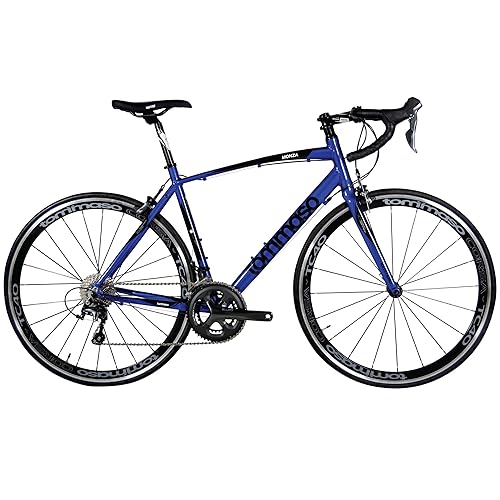
Tommaso Monza Aluminum Road Bike – Shimano Tiagra 20 Speed
If you’re going to spend close to the top of this price range, the Tommaso Monza is where your money goes furthest. It uses a Shimano Tiagra groupset – the same component family you’ll find on road bikes that cost twice as much. Most bikes in this guide are running entry-level Shimano, so Tiagra is a real step up in shift quality and longevity.
The frame is a 6061 SLA aluminum compact road frame paired with a carbon fiber fork. That carbon fork matters – it absorbs road vibration better than an aluminum fork and shaves weight at the front end. The riding position is a true road geometry: drops, aggressive, more aero than a hybrid. You’ll feel the difference the moment you get on it.
The Monza runs a 2×10 drivetrain with a 50/34T crankset and a wide-range cassette, giving you enough gearing for light climbing and real road speeds. The brakes are dual-pivot caliper style, which is standard for this class of road bike. You’re not getting hydraulic disc here, but caliper brakes on a road bike this light stop just fine in dry conditions.
This is the pick if you want a bike that punches well above its price tag and won’t embarrass you on a group ride. If you’re serious about road cycling but can’t swing a four-figure budget yet, the Monza is your entry point. Check out our best road bikes under $1000 when you’re ready to step up.
- Frame:6061 SLA Aluminum Compact Road Frame
- Fork:Carbon Fiber
- Drivetrain:Shimano Tiagra 2×10 (20 Speed)
- Crankset:50/34T Tiagra Compact
- Brakes:Dual Pivot Caliper
- Wheels:700c
- Handlebars:Drop Bar
- Rider Height:Multiple sizes available (48cm-62cm)
- Best For:Fitness riding, club rides, entry-level road cycling
- Frame Material:Aluminum + Carbon Fork
-
Ecarpat Road Bike 700C – Drop Bar, Shimano 16-Speed
The Ecarpat is a clean, sensible pick for a first real road bike, and it hits a sweet spot of lightweight build, drop bars, and a wider gear range than most bikes at this price. If you want proper road posture without paying for components you won’t notice yet, this is a strong value.
The aluminum alloy frame is light, stiff, and responsive, and it won’t rust like the steel frames on cheaper builds. The drop handlebar gives you multiple hand positions and a more aerodynamic tuck on flat roads, and 700x28C tires roll efficiently while adding a bit more comfort than skinnier race tires.
The Shimano 16-speed drivetrain covers flat roads and rolling hills with gears to spare. If you’re mostly riding around town or on bike paths with modest climbs, 16 speeds handles it with room left over. It arrives 85% pre-assembled – you install the pedals, handlebars, saddle and front wheel and inflate the tires, which takes about 20 minutes.
The Ecarpat is a solid “first real road bike” choice. It rides well for the money and has the drop bar setup that makes a road bike feel like a road bike. If your budget is tighter, our best road bikes under $300 list has more options.
- Frame:Aluminum alloy
- Handlebar:Drop bar
- Speeds:16 (Shimano)
- Tires:700x28C
- Wheels:700c
- Assembly:85% pre-assembled
- Best For:First road bike, fitness riding
-
Pipleo Road Bike 700C – Shimano 21-Speed, Dual Disc Brakes
The Pipleo is built as a city commuter first, and it shows. It pairs a lightweight aluminum frame with a Shimano 21-speed drivetrain that gives you more options when you hit that one killer hill on your way to work. It’s a good bike for people who want road bike efficiency for daily riding without overthinking components.
The aluminum frame uses internal cable routing for a clean look, and the bike rolls on 700x28C tires with double-wall rims that handle city streets and the odd gravel shortcut. Slightly wider tires than a pure race bike mean more comfort over rough pavement, which matters on a daily commute.
With 21 speeds, you have a wider gear range than the 14-speed bikes on this list. That extra low gear is handy if your commute includes real climbs or you’re just starting out and need an easy gear to survive the ride home. Dual disc brakes keep stopping consistent in the rain, and it arrives about 95% pre-built in two frame sizes covering riders from 5’4″ to 6’1″.
I’d pick the Pipleo if commuting is your main goal, or if you’re newer to road bikes and want reliable all-weather braking while you build fitness. For more commuter-friendly options at various price points, take a look at our road bikes under $300 guide or step up to our under $1000 picks if you want a more serious commuter setup.
- Frame:Aluminum, internal cable routing
- Speeds:21 (Shimano)
- Brakes:Dual disc
- Tires:700x28C
- Rims:Double-wall
- Sizes:Two (5’4″ to 6’1″)
- Assembly:About 95% pre-built
- Best For:Commuting, beginners
-
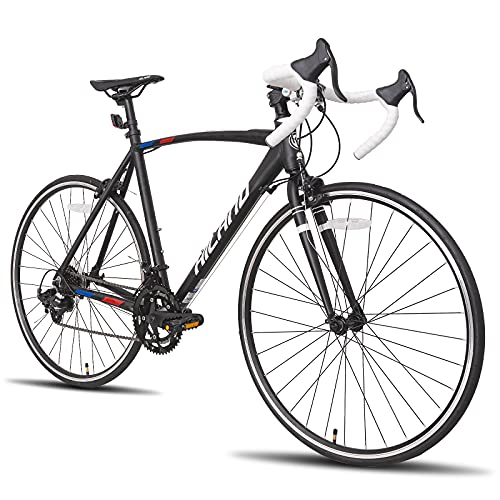
HILAND Adult Road Bike 700c 14 Speeds Aluminum Caliper Brake
HH Hiland has been making affordable road bikes that actually ride decently for years, and this 14-speed model hits the budget sweet spot. It keeps the price low while still giving you an aluminum frame, 700c wheels, and a legitimate 14-speed drivetrain. If you want to spend as little as possible while still getting a real road bike, this is the one to look at.
The ultra-lightweight aluminum frame is built for everyday riding and keeps the weight down to a level where you can actually feel the difference from a steel bike. Internal cable routing keeps the frame clean and protects the cables. Front and rear caliper brakes handle stopping duty – they’re lighter than disc brakes and more than adequate for flat road conditions and moderate speeds.
The 14-speed drivetrain with quick gear changes is enough for most riding scenarios. It gives you a reasonable spread from easy spinning to road speed. The bike comes 90% pre-assembled, and size options run from small (5’3″-5’6″) through medium (5’6″-6′) to large (6′-6’4″).
If your budget is closer to the lower end of this range, the HILAND is worth serious consideration. It’s a capable starter bike that won’t fall apart after a season. The caliper brakes and aluminum frame keep it light, and the assembly process is simple enough to handle in an afternoon. Compare it to our cheap road bikes under $200 list to see what you’d be giving up by spending even less.
- Frame:Ultralight aluminum, internal cable routing
- Drivetrain:14-Speed
- Brakes:Front and Rear Caliper
- Wheels:700c
- Assembly:90% Pre-Assembled
- Sizes:S (5’3″-5’6″), M (5’6″-6′), L (6′-6’4″)
- Best For:Budget beginners, casual road riding, light commuting
-
Schwinn Volare 1300 Road Bike 700c 14-Speed Drop Bar
Schwinn has been making bikes for over a century, and for a lot of people that name recognition matters. The Volare 1300 is one of their current entry-level road bikes and it’s a respectable build for the money. Drop bars, aluminum frame, Shimano-branded shifters, and a proper road bike stance – it does what a beginner road bike needs to do.
The 17-inch aluminum fitness frame with rigid fork keeps things light, and the 700c wheels with high-profile double-wall rims are a solid foundation. Schwinn specs Shimano EZ-Fire trigger shifters with a rear derailleur for a 14-speed drivetrain. EZ-Fire shifters are a bit different from STI (they’re mounted separately rather than integrated with the brake lever), which some beginners actually find easier to use at first.
The alloy caliper brakes provide reliable stopping, and the sport-style riding seat gives you a bit more comfort than a pure race saddle. The Volare fits riders between 5’4″ and 6’2″ in the standard sizing. It arrives partially assembled – you’ll need some basic tools to finish the build, but the instructions are straightforward.
The main advantage here is the Schwinn name and their warranty support, which counts for something if you have an issue. Compared to the Ecarpat 16-speed, they’re roughly equivalent in performance. Go Schwinn if brand support matters to you. Personally, I’d say the Tommaso Monza is a better value for the performance, but the Volare is a solid, no-surprises choice from a company that’s been around since 1895.
- Frame:17-Inch Aluminum Fitness Frame
- Fork:Rigid Alloy
- Drivetrain:14-Speed (Shimano EZ-Fire)
- Shifters:Shimano EZ-Fire Trigger Shifters
- Derailleur:Shimano Rear
- Brakes:Alloy Caliper
- Wheels:700c High-Profile Double-Wall Rims
- Handlebars:Drop Bar
- Rider Height:5’4″ to 6’2″
- Best For:Beginners who want a trusted brand, fitness riding
-
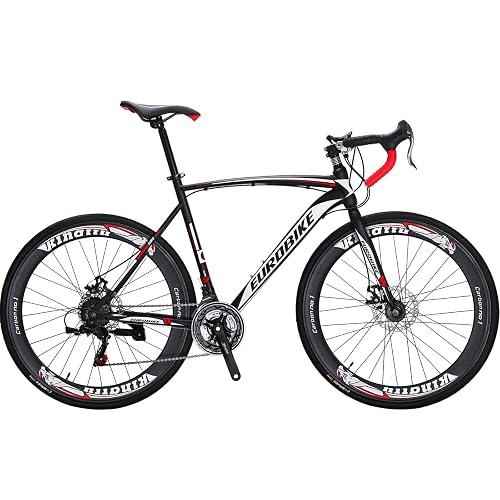
EUROBIKE Road Bike 21 Speed 700C Disc Brake
The Eurobike is the one bike on this list that leads with disc brakes as its main selling point, and it’s worth talking about why that matters at this price point. Disc brakes – even mechanical disc, not hydraulic – give you noticeably better stopping performance in wet weather. If you ride through rain or damp conditions regularly, the Eurobike earns its place on this list based on that feature alone.
The Shimano 21-speed drivetrain is one of the fuller gear ranges on this list, giving you solid flexibility across varied terrain. The 700c wheels with aluminum rims roll efficiently, and the overall frame geometry is designed around competitive road bike proportions – more upright than a pure race bike, but not hybrid-level relaxed. The frame is designed to accommodate riders looking for a road feel with added braking security.
One honest note: the Eurobike frame uses steel in some variants (check the specific listing before buying). Steel is heavier than aluminum – typically adding 2-3 lbs – which matters if you care about weight. The disc brakes are mechanical, not hydraulic, so they require cable tension adjustments over time just like caliper brakes. They’re still a clear upgrade over calipers in wet conditions, though.
The Eurobike comes 85% pre-assembled and is straightforward to finish up at home. If you’re planning to ride in unpredictable weather conditions or want the peace of mind of disc braking without spending $800+, this is your best option in the sub-$500 range. Worth pairing with a look at our road bikes under $1000 if you want to see what proper hydraulic disc systems look like at the next level.
- Frame:Road Bike Frame (check listing for material)
- Fork:Road Bike Fork
- Drivetrain:21-Speed Shimano
- Brakes:Mechanical Disc (front and rear)
- Wheels:700c with Aluminum Rims
- Frame Sizes:49cm and 54cm
- Assembly:85% Pre-Assembled
- Best Condition:Wet weather, commuting, mixed conditions
- Handlebars:Drop Bar
- Best For:Riders who ride in rain or want disc brake stopping power
-
ItWorths 700c Aluminum Road Bike with Drop Bar, 16 Speed
The ItWorths is a classic entry-level road bike in the best sense: aluminum frame, drop bars, 700c wheels, and a simple drivetrain. Nothing fancy – just a clean road bike that gets you pedaling with proper road posture from day one.
The 20-inch aluminum alloy frame keeps the bike lightweight and rust-free, and it’s sized for riders from 5’6″ to 6’3″ with a 250 lb weight limit. The drop bars put you in a real road riding position – more aggressive than a hybrid, which means faster and more efficient on flat roads.
The 16-speed gear system uses indexed shifters with a gear indicator, so you always know which gear you’re in. Dual disc brakes give you reliable stopping on wet roads and steep descents, and 700c x 28c tires on alloy rims add a bit of comfort and grip over skinny race rubber. It arrives 85% pre-assembled with a toolkit and reflectors.
The ItWorths is a good pick if you want a no-frills drop bar road bike with confident braking. Note that it comes in a single frame size, so check the height range first – if you’re shorter than 5’6″, look at the three-size HILAND models instead. Compare it to our bikes under $300 if you’re shopping at the bottom of the budget.
- Frame:20-inch aluminum alloy
- Handlebar:Drop bar
- Speeds:16, indexed with gear indicator
- Brakes:Dual disc
- Tires:700c x 28c
- Rider Height:5’6″ to 6’3″
- Max Load:250 lbs
- Assembly:85% pre-assembled
-
HILAND 700C Road Bike 14 Speeds Sport Bike Lightweight Aluminum
The second HILAND on this list earns its spot by being one of the newer budget road bike designs available right now. HILAND updated their lineup recently, and this sport model has a slightly more refined aluminum frame compared to their older builds. It’s a 14-speed setup with caliper brakes – clean, lightweight, and straightforward to ride and maintain.
The lightweight aluminum frame is built with everyday commuting and fitness riding in mind. Where some budget road bikes use heavier tube sets that drag the weight up above 27 lbs, the HILAND sport model keeps things noticeably lighter. The caliper brakes are easy to set up and give you consistent stopping, and they’re lighter and simpler to maintain than disc brakes for road conditions. Internal cable routing keeps the look clean.
The 700c wheels give you solid rollover on road surfaces, and the drop handlebar gives you multiple hand positions. The 14-speed drivetrain handles flat to gently hilly terrain without complaint. Size options cover S (49cm, for riders 5’3″-5’6″), M (53cm, 5’6″-6′), and L (57cm, 6′-6’4″) – three sizes is more than you get on some competing builds at this price, which makes dialing in fit easier.
If you already looked at the HILAND 14-speed caliper model above and want a newer version with a cleaner aesthetic, this is it. Both are solid choices and both come in three frame sizes. Either way, HILAND provides good bang for budget, and both arrive mostly pre-assembled.
- Frame:Ultralight aluminum, internal cable routing
- Handlebar:Drop bar
- Drivetrain:14-Speed
- Brakes:Caliper (front and rear)
- Wheels:700c
- Sizes:S (49cm), M (53cm), L (57cm)
- Best For:Beginners and fitness riders who want a newer build with multiple size options
How to Choose a Road Bike Under $500
There are a few things that really separate a good budget road bike from a frustrating one – and most of them aren’t the ones people focus on when they’re shopping.
What $500 Actually Buys in Road Bikes
At this price point, you’re getting the basics done right: an aluminum frame, a Shimano-branded drivetrain, 700c wheels, and either caliper or mechanical disc brakes. What you’re NOT getting is a carbon frame, hydraulic disc brakes, a quality saddle, or clipless-pedal-compatible pedals. Plan on swapping the saddle within the first few months – stock saddles on budget bikes are notorious for being uncomfortable. Budget $20-40 for a replacement. You should also budget for proper pedals if you go clipless eventually. The Tommaso Monza gives you the best component value at the top of this range; the HILAND models give you the most bike per dollar at the lower end.
Aluminum vs Steel vs Carbon (Why Carbon Isn’t Here)
Every bike on this list uses aluminum – and that’s intentional. Aluminum is lighter than steel, doesn’t rust, and rides with a stiffer, more road-bike-like feel. Steel road bikes exist at this price but they’re noticeably heavier (think 28-32 lbs vs 24-26 lbs for aluminum), which you feel immediately on any kind of incline. Carbon frames at this price point are not real carbon – any listing claiming a “carbon frame” under $500 is either referring to the fork only (like the Tommaso Monza) or is misleading you. Carbon forks are legitimate and do improve ride quality by absorbing vibration; carbon frames at $500 are not.
Drivetrain: Why Speed Count Matters Less Than You Think
You’ll see everything from 14-speed (HILAND, Schwinn Volare) to 21-speed (Pipleo, Eurobike) to 20-speed Shimano Tiagra (Tommaso Monza) on this list. Here’s the honest take: for flat to moderately hilly terrain, 14 speeds is plenty. The bigger question is component quality. The Tommaso Monza’s Shimano Tiagra is genuinely better-quality shifting than the basic Shimano on a 21-speed budget build. More speeds doesn’t automatically mean better – it can mean more things to adjust and more cables to replace. If you’re planning to ride in hilly terrain regularly, prioritize a wider gear range (lower low gear). If you’re mostly on flat ground, any drivetrain on this list will serve you.
Caliper vs Disc Brakes at This Price
Most of the bikes here use caliper brakes – the Eurobike and Schwinn Volare are the exceptions with disc brakes. Caliper brakes are lighter, easier to maintain, and work great in dry conditions. Disc brakes – even mechanical disc like on the Eurobike – give significantly better stopping in wet weather. If you ride through rain regularly or live in a wet climate, the Eurobike is worth considering specifically for this reason. If you ride mostly in dry conditions, caliper brakes are fine and actually preferred by many road cyclists for their weight and simplicity.
Fit and Sizing (More Important Than You’d Think)
Road bikes are less forgiving on fit than mountain bikes or hybrids. A drop bar road bike that’s too small or too large is genuinely uncomfortable to ride – you’ll end up with neck and wrist pain before long. Most bikes on this list come in multiple sizes. Use height as a rough guide: 49-50cm for riders around 5’3″-5’6″, 52-54cm for 5’6″-5’10”, 56-58cm for 5’10”-6’1″. When in doubt between two sizes, go up – a slightly too-big road bike is more comfortable than a slightly too-small one. The Giordano Libero and the HILAND sport model both offer the most size variety on this list.
Upgrades You’ll Probably Want Within a Year
Every budget road bike has weak links. Here’s what to expect: the saddle will likely be the first thing you replace – stock saddles are built to a cost and rarely comfortable for more than short rides. Budget $25-60 for an aftermarket saddle. The pedals that come with these bikes are basic platform pedals; if you want clipless pedals (which dramatically improve efficiency), that’s another $40-80 including cleats and shoes. Cable housings and brake pads are the next wear items – plan for a tune-up or cable replacement around the 1-year mark. None of this is a surprise with budget bikes; it’s just the cost of entry-level ownership.
Road Bike Under $500 Comparison
Side-by-side specs for all eight bikes to make the decision easier.
| Bike | Frame | Speeds | Brakes | Handlebars | Best For |
|---|---|---|---|---|---|
| Tommaso Monza | Aluminum + Carbon Fork | 20 (Tiagra) | Caliper | Drop Bar | Performance-focused beginners |
| Ecarpat 16-Speed | Aluminum Alloy | 16 (Shimano) | Dual | Drop Bar | First road bike, fitness riding |
| Pipleo 21-Speed | Aluminum | 21 (Shimano) | Dual Disc | Road | Commuting, beginners |
| HILAND 700c 14-Speed (caliper) | Lightweight Aluminum | 14 | Dual Caliper | Drop Bar | Budget-first buyers |
| Schwinn Volare 1300 | Aluminum 17″ | 14 (EZ-Fire) | Alloy Caliper | Drop Bar | Brand-conscious buyers |
| EUROBIKE 21-Speed Disc | Road Frame | 21 (Shimano) | Mechanical Disc | Drop Bar | Wet weather riders |
| ItWorths 16-Speed | Aluminum | 16 | Dual Disc | Drop Bar | Classic road feel, confident braking |
| HILAND 700c Sport 14-Speed | Lightweight Aluminum | 14 | Caliper | Drop Bar | Beginners wanting 3 size options |
Frequently Asked Questions
The most common questions people ask before buying their first budget road bike – answered straight.
Is a $500 road bike actually worth it?
Yes, with the right expectations. A $500 road bike is a genuine road bike – aluminum frame, Shimano drivetrain, 700c wheels, and a road geometry. It’s not a race bike and it’s not going to last 10 years without upgrades, but it will get you on the road, build fitness, and let you figure out if road cycling is actually for you before spending $1,500+. The Tommaso Monza in particular overdelivers for its price. Just don’t expect it to perform like something from a specialty bike shop.
How long will a budget road bike last?
With basic maintenance, 3-5 years of regular use is realistic. The frame will outlast the components – aluminum road frames are durable. What wears out first are cables, brake pads, tires, and eventually the drivetrain (chain, cassette, chainrings). If you ride 3-4 times a week year-round, budget for a tune-up every 12-18 months and component replacements around the 2-3 year mark. The Tommaso Monza’s Tiagra components will last noticeably longer than the basic Shimano on cheaper builds before needing replacement.
Can I use a budget road bike for commuting?
Absolutely – and it’s one of the best uses for a bike in this price range. The Pipleo 21-speed and the Schwinn Volare 1300 are both well-suited for daily commuting. Things to add: a rear rack or pannier if you carry a bag (check rack mounts before you buy), fenders if you ride in rain, a decent lock, and lights front and rear. Budget $50-80 for commute accessories on top of the bike. The Eurobike disc brake model is worth a look if your commute involves wet roads.
Should I save for a $1000 bike instead?
If you already know you love road cycling and plan to ride seriously, yes – the jump from $500 to $1,000 gets you meaningfully better components, a more refined frame, and better long-term durability. But if you’re not sure yet, or if $500 is your real ceiling, don’t wait. A $500 bike you ride is better than a $1,000 bike you’re saving for. Start with the Tommaso Monza or Ecarpat 16-speed, ride it for a season, and see our best road bikes under $1000 and best road bikes under $1500 when you’re ready to upgrade.
Will I need to upgrade anything immediately?
The saddle is the most common immediate upgrade. Stock saddles on budget road bikes are almost universally uncomfortable for rides longer than 30-45 minutes. A decent aftermarket saddle ($25-50) makes a bigger difference than any other single upgrade. Beyond that, check that the brakes are adjusted properly out of the box and that the derailleur is indexed correctly – both are common out-of-the-box issues that take 5 minutes to fix once you know what to look for. If you plan to ride clipless (clip-in pedals), factor in pedals and shoes as a Day 1 expense.
What’s the difference between $300 and $500 road bikes?
Mostly components. At $300 (see our road bikes under $300 list), you’re looking at basic 7-speed setups, single-wall rims, and the most entry-level Shimano components. At $500, you get double-wall rims, better Shimano shifters (Tiagra on the Tommaso Monza), and generally cleaner welds and finishes on the frame. The ride feel improves meaningfully. The $200 difference is worth it if you plan to use the bike regularly – you’ll notice it in shift quality, wheel durability, and overall build tightness almost immediately.
🚲 Free: The Smart Bike Buyer’s Cheat Sheet
Get our 2-page PDF - budget tiers, the components that actually matter, and a 12-point used-bike inspection. We'll email you the download link. No spam, unsubscribe anytime.
By subscribing you agree to our Privacy Policy.