
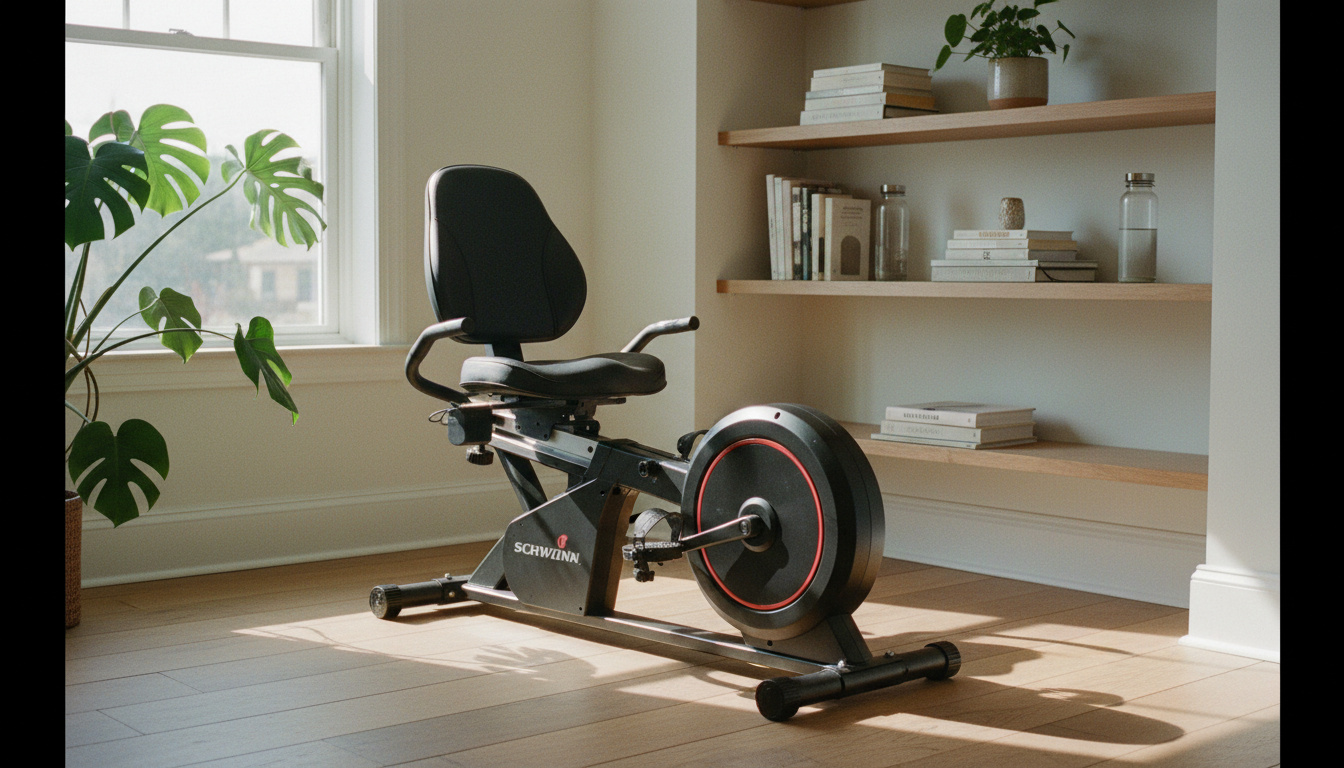
The Schwinn 270 is one of the best-known mid-range recumbent bikes: 25 magnetic resistance levels, 29 built-in programs, Bluetooth and a 300 lb user limit. It is also a bike you may have trouble buying right now, so this page covers both the specs and what to do about that.
Availability update (checked October 5, 2026): Amazon currently shows the Schwinn 270 as unavailable, with no buyable offer. We have not verified other retailers.
The Schwinn recumbent you can buy on Amazon right now is the Schwinn 230, covered in the comparison below. If you land here from a search for the 270, the specs in this review are still accurate for the bike if you find one elsewhere or buy it used.
Everything below comes from Schwinn’s service and owner documentation and the maker’s listing text, not from hands-on testing.
Schwinn 270 Specs at a Glance
Numbers first, opinions second. Here is what Schwinn says you get.
| Spec | Details |
|---|---|
| Resistance | 25 levels, magnetic |
| Workout programs | 29: 12 profile, 9 heart rate control, 4 custom, 2 fitness test, 1 quick start |
| Display | Dual-track LCD console |
| Connectivity | Bluetooth, syncs with the Schwinn Trainer app and other fitness apps |
| Heart rate | Contact grips plus telemetry (uncoded Polar-type chest strap, not included) |
| Audio | Built-in speakers, played through the audio cable port (Bluetooth does not stream audio to the bike) |
| Fan | Yes |
| USB charging | Yes |
| Max user weight | 300 lb (136 kg) |
| Machine weight | 86.6 lb |
| Dimensions (L x W x H) | 64 in x 27.7 in x 49.9 in |
| Warranty (US/Canada) | 10-year frame, 2-year mechanical, 1-year electronics, 90-day labor |
Can You Still Buy the Schwinn 270? The 230 Is the Available Alternative
If the 270 is not in stock where you look, the Schwinn 230 is the closest Schwinn you can order from Amazon today.

Schwinn Fitness 230 Recumbent Bike
16 magnetic levels, 13 programs, Bluetooth, 300 lb limit.
View the Schwinn 230 on AmazonIf you would rather wait for the 270, you can check the Schwinn 270 listing on Amazon for a restock.
Schwinn 270 vs. Schwinn 230: The Main Differences
Same brand and same 300 lb limit, but the 270 has more of everything and the 230 handles a few things differently.
| Feature | Schwinn 270 | Schwinn 230 |
|---|---|---|
| Resistance levels | 25 magnetic | 16 magnetic |
| Workout programs | 29 (4 custom) | 13 |
| Display | Dual-track LCD | 5.5 in LCD |
| Heart rate | Contact grips + telemetry (uncoded Polar-type strap) | Contact grips + Bluetooth heart rate tracking |
| Apps | Schwinn Trainer app | Explore the World and Zwift (separate subscriptions) |
| USB charging | Yes | No, per Schwinn’s product page |
| Fan | Yes | Not listed on Schwinn’s page |
| Max user weight | 300 lb | 300 lb |
| Height | 49.9 in | 44 in |
| Machine weight | 86.6 lb | 81.6 lb |
| Warranty (US/Canada) | 10 yr frame, 2 yr mechanical, 1 yr electronics, 90 day labor | Same terms |
The practical split: the 270 gives you more resistance steps, more programs, a fan and a USB port. The 230 gives you modern Bluetooth heart rate and app support but fewer steps and programs. If you already own a Bluetooth chest strap, check which one the bike you pick can actually pair with, because the two bikes handle straps differently.
Who Should Consider the Schwinn 270
Recumbent bikes are not for everyone, but if you fit the right profile, this design makes sense.
The 270 is a reasonable fit for:
- Riders who find an upright saddle uncomfortable and prefer a seat with a backrest
- People who want low-impact cardio at home
- Anyone who likes structured programs, including heart rate control programs
- Riders under the 300 lb user limit who want a wide range of resistance steps
The 270 is probably not the right pick for:
- Anyone who needs a folding or compact bike (it is 64 in long and 86.6 lb)
- Riders who want streamed classes or live leaderboards on the bike’s own screen
- Riders heavier than 300 lb, who should look at bikes rated higher
- Anyone who needs a new bike this week, given the current availability
Schwinn 270: Pros and Cons
Every bike has trade-offs. Here is the honest version, based on the published specs.
| Pros | Cons |
|---|---|
| 25 resistance levels for fine adjustments | Currently unavailable on Amazon |
| 29 programs, including 9 heart rate control programs | Heart rate telemetry needs a separate uncoded Polar-type chest strap |
| Contact grips plus telemetry heart rate | Heart rate readings are approximations, per Schwinn’s own label |
| Fan and USB charging port built in | Bluetooth does not stream audio to the bike, so music needs the audio cable |
| Bluetooth sync with the Schwinn Trainer app | LCD console, not a screen for streaming classes |
| 10-year frame warranty | Electronics are covered for 1 year |
| 300 lb user limit | Larger footprint and heavier than the 230 |
Resistance and Programs
This is where the 270 separates itself from basic recumbents with 8 or 16 levels.
Schwinn lists 25 levels of magnetic resistance. More steps means smaller jumps between levels, which helps if you like to adjust gradually or run intervals. Remember that level numbers are not comparable between brands, so a level 10 here says nothing about a level 10 on another bike.
The 29 programs break down as 12 profile programs, 9 heart rate control programs, 4 custom programs, 2 fitness tests and 1 quick start. In plain terms: a manual mode, hill and interval style profiles, programs that adjust resistance to hold a target heart rate, and four slots for your own workouts.
Heart Rate: Contact Grips vs. Chest Strap
The 270 reads heart rate two ways, and the way you pick matters for the heart rate control programs.
The contact grips on the handlebars need no accessories. Schwinn’s service manual notes that dry or calloused hands can make contact readings harder, and that hands should stay still with even pressure on both sensors. For telemetry, the console reads signals from a chest strap in the 4.5 to 5.5 kHz range, and Schwinn’s manual says the strap must be an uncoded Polar-type strap. A strap is not included, and the manual does not describe pairing a Bluetooth-only strap.
Schwinn also states on the bike that the displayed heart rate is an approximation for reference only. If you have a heart condition or take medication that affects heart rate, ask your doctor before relying on any heart rate program.
Connectivity and Audio
Bluetooth on the 270 is for data, not for music.
The bike syncs with the Schwinn Trainer app and other fitness apps for workout tracking. For music, Schwinn’s service manual says to connect your device to the audio cable port on the console and play through the built-in speakers. The same manual states the machine cannot receive and play audio over a Bluetooth connection.
Fit and Comfort: What to Check
Comfort is the whole point of a recumbent, and the right fit depends on your leg length more than on any spec sheet.
We have not published seat adjustment figures because Schwinn’s documents we checked did not give a rider height range. Before you buy any recumbent, compare the seat rail travel and pedal reach against your inseam, and check that the bike’s footprint (64 in x 27.7 in on the 270) fits your room.
More Recumbent Bike Guides
If you are still choosing, these guides compare more bikes on the points that matter.
- Best recumbent bikes for weight loss: eight comfortable picks across different feature sets
- Best budget recumbent bikes: simpler bikes if you do not need the 270’s feature list
- Best exercise bikes: upright, spin and recumbent compared
- Best exercise bikes for small spaces: the 270 is not compact, so start here if space is tight
Frequently Asked Questions
Is the Schwinn 270 still available?
As of October 5, 2026, Amazon shows it as currently unavailable. We have not checked other retailers. The Schwinn 230 is available on Amazon and is the closest current Schwinn recumbent.
How does the Schwinn 270 compare to the 230?
The 270 has 25 vs 16 resistance levels and 29 vs 13 programs, plus a fan and USB charging. The 230 has a 5.5 in LCD and works with Explore the World and Zwift (separate subscriptions). Both list a 300 lb limit and the same warranty terms.
Does the Schwinn 270 work with a Bluetooth chest strap?
Schwinn’s manual describes telemetry heart rate from an uncoded Polar-type chest strap, plus contact grips. It does not describe pairing a Bluetooth heart rate strap, and a strap is not included.
Can I play music through the Schwinn 270 speakers over Bluetooth?
No. Schwinn’s service manual says the bike cannot receive audio over Bluetooth. Use the audio cable port on the console to play audio through the built-in speakers.
Is the Schwinn 270 good for weight loss?
No bike causes weight loss by itself. Weight change comes from regular physical activity combined with what you eat, and a comfortable recumbent can make regular low-impact exercise easier to stick with. Talk to your doctor before starting a new exercise routine.
What is the weight limit?
Schwinn lists a maximum user weight of 300 lb (136 kg) for the 270.
🚲 Free: The Smart Bike Buyer’s Cheat Sheet
Get our 2-page PDF - budget tiers, the components that actually matter, and a 12-point used-bike inspection. We'll email you the download link. No spam, unsubscribe anytime.
By subscribing you agree to our Privacy Policy.
