
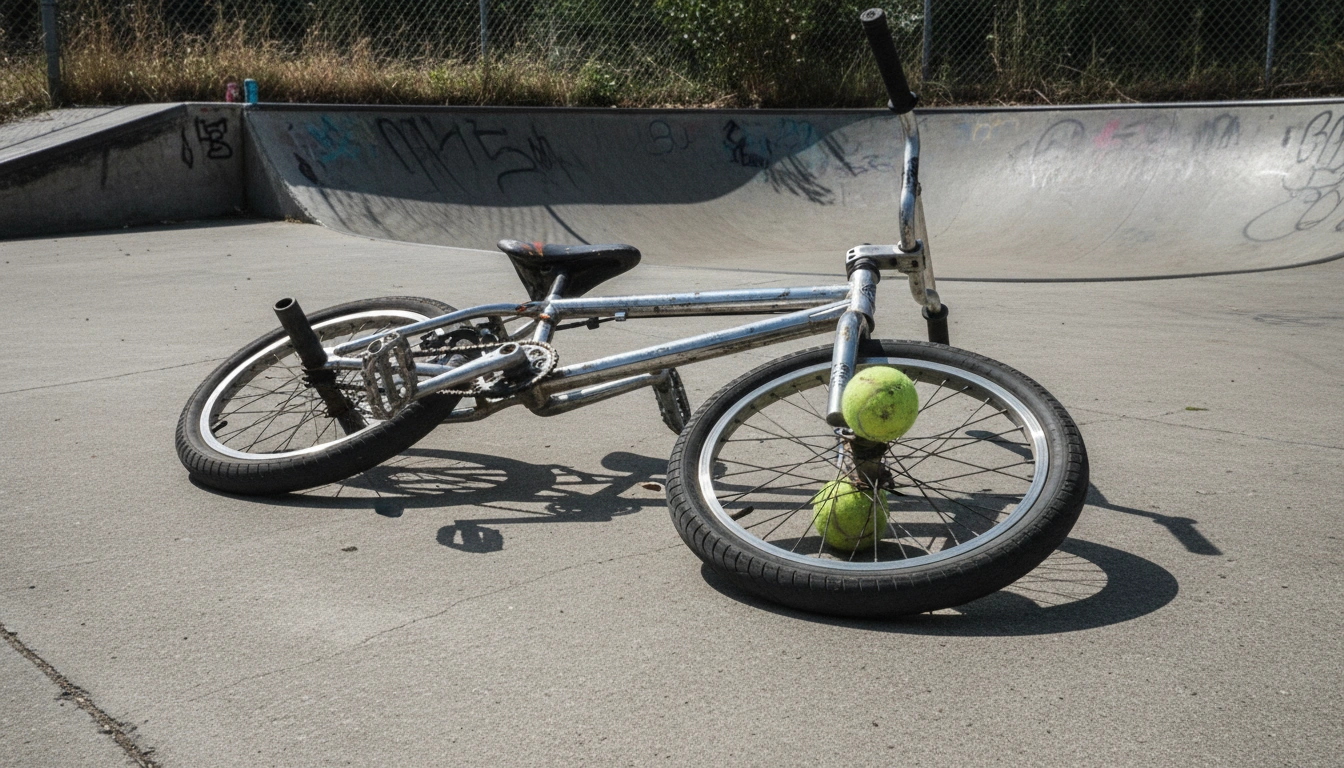
A question has been puzzling people for years: why do BMX riders put tennis balls in their spokes? It seems like an odd thing to do, and it doesn’t seem to serve any real purpose. Or does it?
Turns out there are a handful of real reasons riders do it – some practical, some purely about looking cool. Let’s break it all down.
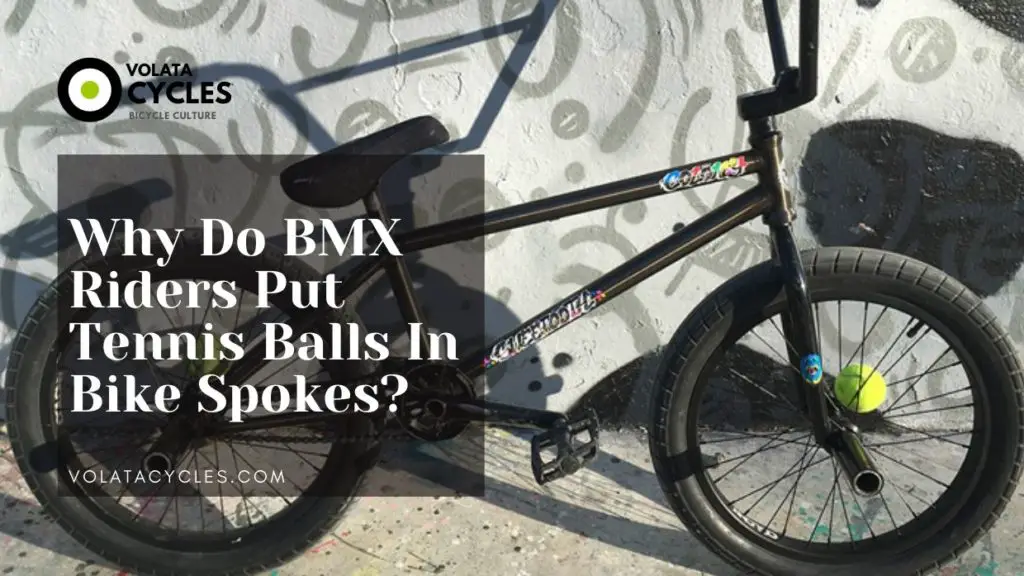
The Real Reasons BMX Riders Do It
Spoiler: it’s not because tennis balls make your bike faster. Nobody’s winning races because of a fuzzy green ball jammed in their rear wheel. But that doesn’t mean there aren’t reasons to do it.
The sound. This is the big one. When a tennis ball sits in your spokes and the wheel spins, it creates a satisfying thwacking noise. Kids figured this out decades ago with playing cards, and the tennis ball is basically the next evolution of that. You hear a rider coming from half a block away, and that’s kind of the point.
Intimidation factor. BMX parks have an unwritten social layer that most people outside the community don’t notice. Your bike setup says something about who you are. A tennis ball in the spokes is a low-key signal – it says you ride hard, you don’t care about weight savings, and you’re not taking yourself too seriously. That combination is oddly effective at the skate park.
Style and personalization. BMX culture has always been about making your bike yours. Custom colors, sticker bombs, pegs, grips – and yes, a tennis ball in the spokes. It’s low effort, costs nothing, and makes your bike immediately recognizable. Kids especially love this because you can swap the ball out any time you want a new look.
Shock absorption (sort of). This one is debatable, but the tennis ball does provide a small cushion around the spoke where it sits. On super rough surfaces it may dampen a tiny bit of vibration through the wheel. Don’t expect miracles, but it’s not nothing either.
Noise reduction. A loose spoke rattles. A spoke card or tennis ball pressed against the spokes can quiet things down. This is more of a side benefit than a reason to do it, but riders who ride older or beat-up bikes sometimes notice it.
History of Spoke Decorations in BMX
People have been sticking things in bike spokes for as long as bikes have existed. BMX riders just took it further than anyone else.
The earliest version most people remember is the playing card. Clip one to the frame with a clothespin so it hits the spokes as the wheel turns, and suddenly your bike sounded like a motorcycle. Every kid in the 1970s and 80s did this. It cost nothing and drove parents mildly insane, which made it even better.
When BMX took off through the 1980s, riders started treating their bikes more like skateboards – as an expression of culture and identity. Companies started printing official spoke cards (flat pieces of cardstock that slip between spokes) as promotional items at races. Riders collected them like trading cards.
The tennis ball version likely picked up steam in the 1990s as BMX freestyle grew. Freestyle is less about speed and more about style, so riders had more reason to personalize their bikes in weird, creative ways. A tennis ball is easy to find, easy to install, and looks deliberately low-fi in a way that fits the DIY spirit of the sport. Today it’s a nod to that whole culture – younger riders do it because they’ve seen older riders do it.
Other Things BMX Riders Put in Their Spokes
Tennis balls are just the most famous option. Riders have stuffed all kinds of things in their spokes over the years, and some of them are way more creative than a repurposed tennis ball.
Spoke cards. These are flat, usually circular pieces of card that slip between the spokes and display a design, logo, or message. Messenger cyclists made them popular as a way to show off their city or crew. BMX riders adopted them too. You’ll see them at competitions, handed out like flyers.
Beads. Stringing beads onto individual spokes gives you a rattling sound effect and a custom look. It takes more time than the tennis ball method but you can get surprisingly creative with color patterns. Popular with younger riders and kids who want their bike to look unique without any tools required.
Reflectors. The practical version. Some riders clip reflectors onto their spokes for visibility at night. These actually serve a real safety purpose – cars spot the moving light pattern from reflectors faster than static lights. Not exactly a BMX culture statement, but worth knowing about.
Zip ties. This sounds strange but it works for creating that spinning click sound. Loop a zip tie so it catches the spokes as the wheel turns. It’s almost completely silent at low speed and gets louder as you go faster. Budget version of the playing card trick.
Small toys and figures. You’d be surprised how far people take this. Small plastic dinosaurs, action figures, anything with a hole in it that can be threaded onto a spoke. At this point it’s pure self-expression and nothing else, which is honestly the point of most of this stuff anyway.
If you’re shopping for a bike to actually ride – rather than just customize – check out our guide to the best BMX bikes for adults for solid options across different budgets.
Does It Damage Your Wheels?
This is the practical question that parents and newer riders always ask, and the honest answer is: it depends on how you do it.
A single tennis ball sitting loosely in the spokes is unlikely to cause any serious damage. The spoke itself is strong, and the rubber/felt of the tennis ball is soft. The bigger risks are more about what happens over time and at speed.
Falling out at speed. If the tennis ball isn’t secured properly and it dislodges while you’re riding, it can jam between the wheel and the fork or frame. That can lock up your wheel instantly. It’s rare, but it has happened. Always make sure the ball is snug before you ride.
Unbalanced wheels. One tennis ball adds maybe 55-60 grams to one side of your wheel. At slow park speeds this is completely irrelevant. If you’re doing wheel-sensitive tricks or riding at higher speeds, you may notice slight imbalance over time. Not a dealbreaker, but worth knowing.
Spoke stress. If you stuff a ball in so tight that it’s pulling on the spoke under constant tension, that’s not great for long-term spoke health. Push it in snugly, not forcefully. The goal is friction fit, not a permanent press.
Cosmetic wear. The fuzzy texture of a tennis ball can wear down slightly against the rim or other spokes. Doesn’t affect function, just looks rougher over time. If aesthetics matter to you, swap out the ball every few months.
Bottom line: for casual riding and park use, a properly attached tennis ball is not going to wreck your wheel. Just don’t jam it in carelessly and forget about it.
How to Properly Attach a Tennis Ball to Your Spokes
This is simpler than most tutorials make it sound. You don’t need special tools or any real skill – just a tennis ball and about five minutes.
What you need:
- One tennis ball (used is fine)
- A knife or sharp scissors
- Optional: electrical tape or a zip tie to secure it further
Step 1: Make the cut. Use a sharp knife to cut a small slit in the tennis ball – about 1 to 1.5 inches long. You want it large enough to fit over a spoke but small enough to grip it tightly. Cut in a straight line through the rubber, not a tear.
Step 2: Choose your spoke. Pick a spoke near the center of the wheel, not right next to the hub or rim. This is where there’s the most clearance. On a rear wheel, avoid the drive side (where the chain runs) since you don’t want anything interfering with your chain line.
Step 3: Push it on. Open the slit and push the spoke through it. Work the ball up the spoke until it’s roughly centered between the hub and the rim. It should hold itself in place through friction. Give it a shake – if it slides freely, the cut is too wide and you’ll want to start with a new ball.
Step 4: Secure it (optional but recommended). Wrap a small piece of electrical tape around the spoke just below the ball to create a stop. This prevents the ball from sliding down during a hard ride. Some riders skip this step entirely; others swear by it. Depends how much you trust your cutting job.
Step 5: Test spin. Give the wheel a slow spin by hand. Watch that the ball doesn’t catch on anything – the frame, fork, brake cable, or other spokes. If it rubs on anything, reposition it or remove it.
That’s honestly all there is to it. The whole process takes about three minutes once you’ve done it once. Kids 8 and up can do this with a little adult supervision on the cutting step.
If you’re looking for a younger rider’s first bike to do this kind of thing on, our guide to the best 18-inch BMX bikes covers great options for kids who are getting serious about riding.
Frequently Asked Questions
These are the questions people keep asking about tennis balls in bike spokes. Short answers only.
What about a tennis ball on the front wheel?
Technically you can. Most riders put it on the rear because that’s more visible when you’re riding away from someone. Front wheel works the same way, but you’ve got less clearance near the fork. Make sure it doesn’t rub before you ride.
Can I put more than one tennis ball in my spokes?
Yes, and some riders do put two or three on the same wheel. Just be aware that each one adds weight and drag. More than three starts to feel like you’re actively fighting your own bike. One is usually the sweet spot for the look without the downsides.
Do professional BMX riders use tennis balls in their spokes?
Not in competition, where weight and aerodynamics matter. But you’ll see plenty of pros with spoke decorations of various kinds in their regular riding and social media content. It’s a culture thing more than a performance thing.
Can I use a different type of ball?
A golf ball is too small and too hard to cut safely. A foam ball won’t hold on. A racquetball is close to the right size and the rubber is easier to cut, but it won’t have the fuzzy texture effect. Tennis ball is the standard for a reason – it’s the right combination of size, softness, and grip.
What if I don’t have any cutting tools?
You can use a screwdriver to punch a hole and then work it bigger with a sturdy pen or marker. It’s messier and the slit won’t be as clean, but it works in a pinch. Just make sure the opening is big enough to fit a spoke through without forcing it.
Final Words
Putting tennis balls in your bike spokes is one of those BMX traditions that looks weird from the outside but makes complete sense once you understand the culture. It’s about sound, style, identity, and a little bit of “because I can.”
It won’t make you faster. It might make you slightly slower. But if you’re the kind of rider who cares more about having fun than shaving milliseconds, then a tennis ball in the spokes is completely worth trying. It takes five minutes, costs nothing, and people at the park will ask you about it.
Good enough reasons? Go find an old tennis ball.
🚲 Free: The Smart Bike Buyer’s Cheat Sheet
Get our 2-page PDF - budget tiers, the components that actually matter, and a 12-point used-bike inspection. We'll email you the download link. No spam, unsubscribe anytime.
By subscribing you agree to our Privacy Policy.
