
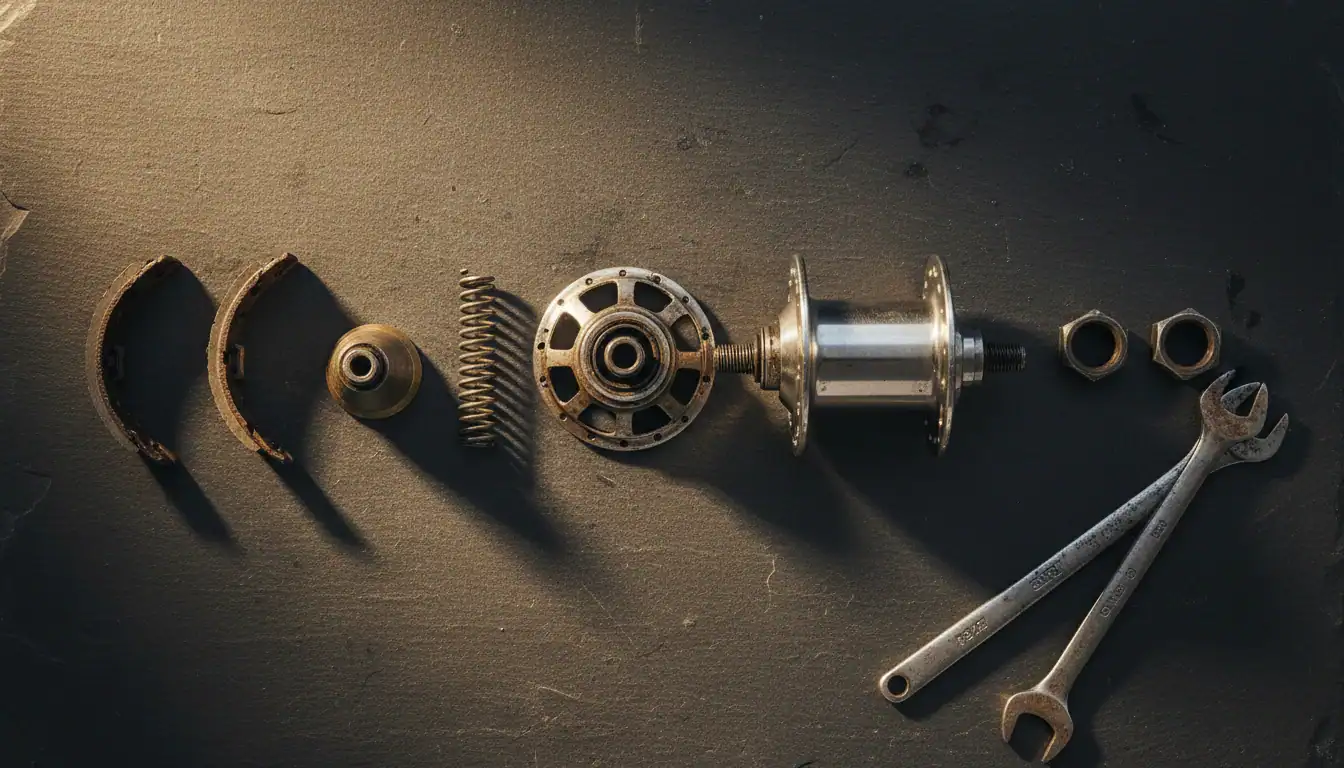
A coaster brake is not commonly used in bicycles in the US, but it is pretty common among transport bicycles in the Netherlands and Denmark.
Basically, a coaster brake is a mechanism attached to the rear wheel that allows a rider to stop or slow down a bike by back-pedaling. And while it’s not as powerful as a conventional lever-operated brake system, it does have some advantages, the biggest of which is that it requires less maintenance.
A lot of riders, however, can seem to get used to using a coaster brake—especially if they’ve been using cable-operated lever brakes for a long time.
If you, for whatever reason, have a bike—or purchased a bike—with a coaster brake installed and want it removed, you can either take it back to the shop and let them do it for you, or you can do it yourself.
Indeed, as long as you have the right tools on hand, it won’t be difficult to disable a coaster brake, and it will only take a few minutes. It is a straightforward job that anyone with a bit of mechanical know-how can do.
In fact, in this article, we’ll teach you how to disable your bike’s coaster brake. Just follow the steps below, and it will be gone in no time!
The tools you will need are two adjustable wrenches and a flathead screwdriver. You might need a lockring wrench depending on the kind of coaster brake installed on your bike.
Step 1
First things first, get your bike onto a stand. If you don’t have one, then position your bike upside down, with the bike resting on its handlebars. This will make it easier to access the rear wheels, which you will need to remove.
Step 2
You’ll want to remove the chain first by pedaling the bike slowly and slipping the chain off—of course, this can only be done if your chain has enough slack. Or, if your bike has a master link, you can undo it, and the chain should come apart. Some chains, however, can only be removed after the rear wheel is unbolted. If this is the situation with your bike, then just go to the next step before you remove the chain.
Step 3
The next step is to remove the rear wheels. The method to do this, of course, will be different for different bikes. Some bikes will have a quick-release lever at the hub area that will allow you to do this easily and without tools. If your bike doesn’t have a quick-release lever, then suffice to say there should be a bolt and nut that holds the wheel to the frame that you will need to remove so the wheel can slide off the rear dropout.
Step 4
For most coaster brakes, there will be a lock nut that keeps the drive in place. Remove the locknut with an adjustable wrench while using a cone wrench on the other side to counterbalance as you turn the adjustable wrench.
Step 5
Once the bolt is removed, there might be a bearing race that will need to be removed, too. You won’t need a wrench for this because turning it until it’s off will do the job.
Step 6
Once that’s done, unscrew the driver (cog-shaped piece) to remove it – the direction varies by hub model, so check which way it threads on yours. You should be able to take everything apart after. Just be sure to remember how they all fit together for when you put everything back in place.
For some coaster brakes, you will notice that instead of a bearing race, it will have a lock ring to keep the drive from coming loose. You will need to remove this lockring with a lockring wrench because a conventional adjustable wrench won’t do the trick.
Step 7
Once every step above is done, you’ll basically be able to pull out the brake cone (expander). This is the part that forces the curved brake shoes outward against the inside of the hub shell when you back-pedal – the shoes themselves sit separately around the cone. Remove the brake shoes and set them aside; you won’t be needing them anymore.
Step 8
You’ll notice a reaction arm (anti-rotation bracket) attached to the hub – this is what prevents the hub internals from spinning freely. Since you are disabling the brake, simply detach this arm from the frame dropout tab or zip-tie it out of the way so it does not interfere once everything is reassembled. Do not try to bend or deform any internal parts.
Step 9
On the inside of the clutch system is a tiny washer. You’ll need to remove this, too, to give the clutch enough space to grab the actual gear.
Step 10
Now with the two brake shoes in step 5 removed, and the washer in step 7 removed, put everything back together, and voila, your coaster brake is now disabled.
Safety and Legal Warnings Before You Start
Read this before touching the brake. Disabling a coaster brake is irreversible unless you reinstall the brake components – and not all bikes can easily accept a rim or disc brake retrofit. Consider these points carefully:
- Legal in most US states – federal law (CPSC 16 CFR Part 1512) requires bicycles sold in the US to have at least one working brake. After disabling the coaster brake, you must have a functioning front or rear lever brake installed before riding legally on public roads.
- Children’s bikes – coaster brakes are standard on kids’ bikes because they are intuitive for beginners. Disabling one on a child’s bike leaves them with no braking unless a hand lever brake is added. Install a front caliper brake before allowing the child to ride.
- Cruiser bikes – many single-speed cruisers have no brake mounts for lever brakes. If the frame has no brake mounts, you may need a clamp-on brake adapter. Check your frame before starting.
- Warranty – modifying the brake system typically voids any remaining manufacturer warranty.
What You Will Need
- Two adjustable wrenches (or a cone wrench set)
- Flathead screwdriver
- Lockring wrench (if your hub uses a lockring instead of a bearing race)
- Clean rag and degreaser
- A replacement rear brake lever and caliper if you plan to install a hand brake after
Not sure if a coaster brake bike is right for you in the first place? See our guide to types of bikes to compare cruisers, kids’ bikes, and hybrids side by side.
🚲 Free: The Smart Bike Buyer’s Cheat Sheet
Get our 2-page PDF - budget tiers, the components that actually matter, and a 12-point used-bike inspection. We'll email you the download link. No spam, unsubscribe anytime.
By subscribing you agree to our Privacy Policy.

The Steps to Removing the Rear Bike Wheel Without Quick Release: It’s wise to lay your bicycle down on its side with the chain facing up. This next step is done by shifting your gear to the smallest cog and having your chain on it. The third step is to disengage the brakes. This depends on what type of brake your bike is using. The fourth step is to loosen the wheel nuts to detach the derailleur. Simply stand behind the bike. Stabilize the frame with your left hand. Place your right thumb on the wheel nut. Then, use your right fingers to pivot the derailleur all the way back. The rear wheel was completely removed from your bike.