
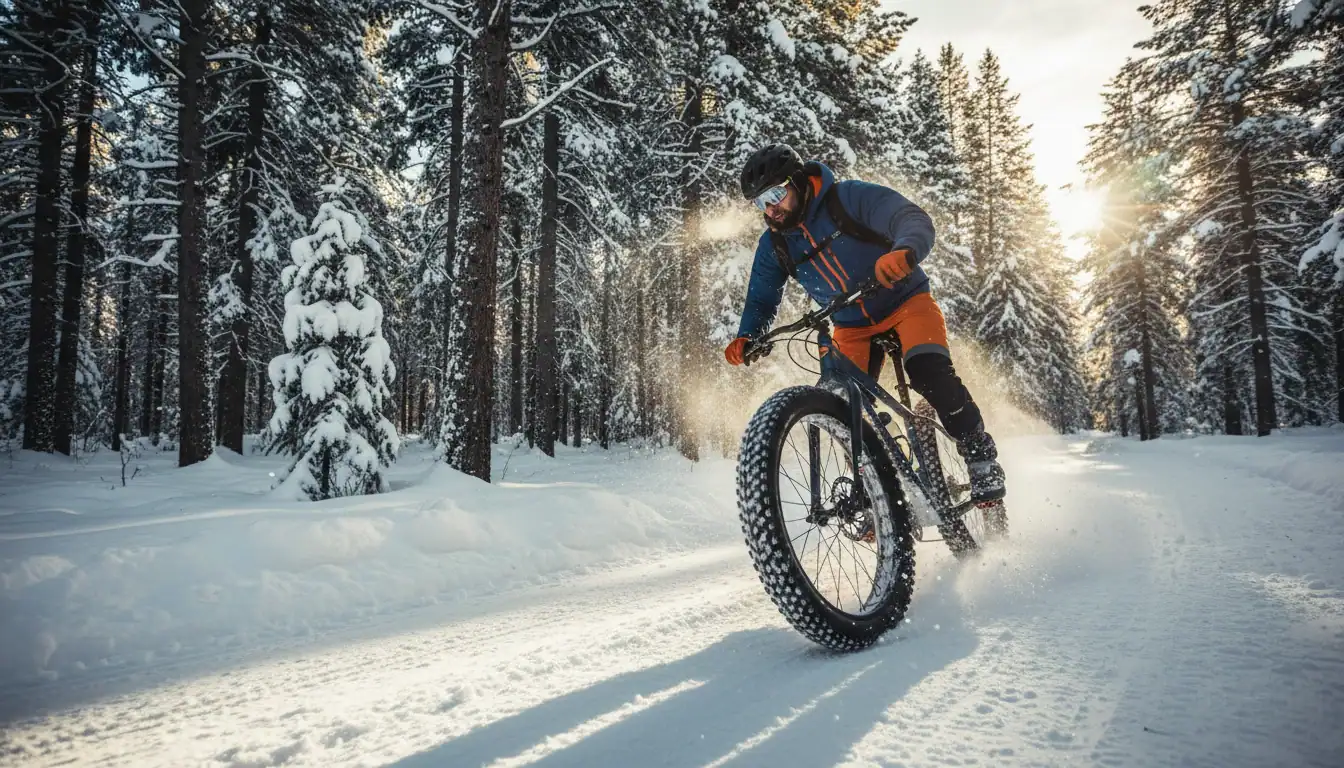
Fat tire bikes are worth buying if you ride on sand, snow, mud, or loose gravel regularly. The oversized tires (3.8-5 inches wide) deliver grip that standard mountain bike tires cannot touch on soft surfaces. The trade-off is real though: they are heavier, slower on hard ground, and more expensive for equivalent quality. Here is the full breakdown – every pro, every con, and a straight answer on who should actually buy one.
Pros and Cons of Fat Tire Bikes at a Glance
Before getting into the details, here is the honest side-by-side so you know what you are signing up for.
| Pros | Cons |
|---|---|
| Exceptional traction on sand, snow, and mud | Heavy – typically 2-4 kg more than a comparable MTB |
| Comfortable ride (high-volume tires absorb bumps) | Slow on hard surfaces due to rolling resistance |
| Very stable and hard to tip over | Sluggish steering response |
| Runs tubeless at very low PSI | Quality fat bikes are expensive ($800+ for decent spec) |
| Opens terrain most bikes cannot handle | Less efficient for climbing on firm ground |
| Beginner-friendly on loose terrain | Overkill if you ride packed trails or roads |
| Year-round riding in cold/snowy climates | Replacement tires and tubes cost more |
| Electric versions add range on difficult terrain | Harder to find parts and service at local shops |
What Counts as a Fat Tire Bike?
The tire width number is everything here. Any bike running tires 3.8 inches (97mm) or wider qualifies as a fat bike – and the distinction matters more than just the number on the sidewall.
A fat tire bike is defined by tire width. Most fat bikes use 4.0-inch or 4.8-inch tires mounted on 26-inch wheels with rims that are 65-100mm wide. The key difference from a standard mountain bike is not just the tires – fat bikes have wider hubs, wider bottom brackets, and frames specifically designed for tire clearance. You cannot simply put fat tires on a regular mountain bike frame.
Fat Tire Width Chart: Which Width Does What
| Tire Width | Category | Best For | Typical PSI |
|---|---|---|---|
| 1.8-2.5″ | Standard MTB | Packed trails, hardpack, XC racing | 25-35 PSI |
| 2.6-2.9″ | Plus tire / wide MTB | Rough trails, light mud, added comfort | 18-25 PSI |
| 3.0-3.7″ | Wide plus / semi-fat | Aggressive trails, some sand and soft ground | 12-20 PSI |
| 3.8-4.0″ | Entry fat bike | Snow trails, hard-packed beach, loose gravel | 8-15 PSI |
| 4.5-4.8″ | True fat bike | Deep sand, fresh snow, mud, expedition touring | 5-10 PSI |
| 5.0″ | Max-volume fat bike | Float on deep soft surfaces, ultra-light pressure | 3-8 PSI |
The Pros: What Fat Tire Bikes Do Well
These are not marketing bullet points – each of these advantages is significant enough to justify owning a fat bike if the terrain matches.
1. Unmatched Traction on Loose Surfaces
This is the primary reason fat bikes exist. A 4-inch tire run at 5-10 PSI (compared to 25-35 PSI for a standard MTB tire) spreads the rider’s weight over a much larger contact area. The tire floats on top of soft surfaces rather than cutting through them.
On beach sand, packed snow, and wet mud, a fat bike will outperform a standard mountain bike regardless of the rider’s skill level. These are surfaces where standard tires simply lose grip or sink. If your riding involves these conditions even a few times a month, the traction advantage alone justifies the weight penalty.
2. Excellent Comfort and Vibration Damping
The high air volume in fat tires acts as natural suspension. Running 8 PSI in a 4-inch tire absorbs rocks, roots, and rough trail chatter effectively. Many fat bike riders skip suspension forks entirely because the tires provide enough compliance on their own. On rocky trails, a rigid fat bike can feel more comfortable than a hardtail MTB running narrow tires at higher pressure.
3. Stability and Confidence for Beginners
The wide contact patch makes fat bikes extremely stable at low speeds and on technical terrain. The bike does not dart away from loose rocks or ruts the way a narrow-tire mountain bike might. For beginners on loose trails, or riders building confidence after an injury, fat bikes lower the skill threshold significantly.
4. Year-Round Trail Access
If you live in a cold climate, a fat bike is the most practical way to ride through winter. Packed snow trails, frozen lake surfaces, and snowy singletrack that shut down for standard mountain bikes are all accessible on a fat bike. Many trail systems now groom fat bike trails specifically during winter months. Whatever you ride, dress for the cold: our winter cycling gear guide covers what to wear at each temperature.
5. Low Maintenance Simplicity (Rigid Builds)
Rigid fat bikes have fewer moving parts than full-suspension mountain bikes. No fork seals to service, no shock to rebuild. The drivetrain is standard and uses the same chains, cassettes, and derailleurs as any other mountain bike. Tubeless fat tires run at such low pressure that pinch flats are virtually non-existent.
The Cons: Where Fat Tire Bikes Fall Short
These downsides are real, and they matter more if your terrain is mostly packed trails or pavement. Do not skip this section.
1. Heavy
Weight is the biggest downside. A budget fat bike weighs 16-18 kg (35-40 lbs). A mid-range fat bike runs 13-15 kg (29-33 lbs). By comparison, a mid-range hardtail mountain bike weighs 11-13 kg (24-29 lbs).
Most of the extra weight is in the tires and wheels. A pair of fat tires weighs 2-3 kg more than standard MTB tires, and the wider rims add another 500g-1 kg. This rotational weight makes acceleration feel sluggish and climbing on firm ground noticeably harder.
2. High Rolling Resistance on Hard Surfaces
Fat tires at low pressure have significantly higher rolling resistance on firm surfaces like pavement or hardpack. The large contact patch deforms as the wheel rolls, and the energy used to flex the tire casing is lost as heat. On paved roads, expect a fat bike to be 3-5 km/h slower than a mountain bike at the same effort level. On hardpack trails, the gap is smaller but still noticeable.
3. Sluggish Handling
The wide tires slow steering response. Changing direction on a fat bike requires more deliberate input compared to a standard MTB. Experienced mountain bikers often find this frustrating on technical terrain where quick, precise steering matters – tight switchbacks, fast singletrack, and flow trails are not where fat bikes shine.
4. Expensive for Quality
Fat bikes carry a price premium over equivalent non-fat bikes. The specialized wide rims, large-volume tires, and reinforced frames cost more to manufacture. A genuinely capable fat bike (reliable components, reasonable weight, tubeless-ready rims) starts at around $800-$1,000. Budget fat bikes under $500 often have heavy steel frames, weak brakes, and tires that are not tubeless-compatible.
Replacement tires are also more expensive: a quality fat bike tire runs $50-80 each, compared to $30-50 for standard MTB tires.
5. Overkill for Most Trail Conditions
Unless your local trails are regularly sandy, muddy, or snow-covered, the fat bike’s advantages do not come into play. On dry hardpack, gravel trails, or groomed singletrack – the most common trail conditions in most regions – a standard 2.3-inch MTB tire outperforms a fat tire in speed, weight, and handling. Fat bikes are specialist tools, not all-round upgrades.
Fat Tire Bike Cost Breakdown: What You Get at Each Price
Price is where a lot of people get burned. The sub-$500 options look like a deal until you ride one – here is what the numbers actually mean.
| Price Range | What You Get | Verdict |
|---|---|---|
| Under $500 | Heavy steel frame (18+ kg), basic 7-speed drivetrain, mechanical disc brakes, non-tubeless rims, budget tires. Examples: Mongoose Dolomite. | Rideable but heavy. Good for casual beach/snow riding if you are not pushing hard. |
| $500-$800 | Aluminum frame, 8-speed drivetrain, improved brakes. Tires may still not be tubeless-compatible. Weight 15-17 kg. | Noticeable improvement over budget tier. Acceptable for regular riders who are not racing. |
| $800-$1,500 | Lighter aluminum or entry-level carbon, 10-12 speed drivetrain, hydraulic disc brakes, tubeless-ready rims, quality fat tires. Weight 13-15 kg. | This is the quality threshold. Most serious fat bikers land here. |
| $1,500-$3,000 | Mid-tier aluminum or carbon, 12-speed drivetrain, quality hydraulic brakes, lighter wheelset, suspension fork option. Weight 12-14 kg. | Strong spec for year-round or expedition use. Makes a real difference on long rides. |
| $3,000+ | Carbon frame, 12-speed top-tier groupset, carbon wheels, full suspension options. Weight 10-12 kg. | High-end trail performance with fat bike capability. Niche but genuinely impressive bikes. |
For a curated list of the best options under $1,000 with current pricing, see our best fat tire bikes under $1,000 guide. If your budget is tighter, the best fat tire bikes under $500 guide covers what is actually worth buying at that price point.
Fat Tire Bike vs Mountain Bike vs Plus-Size MTB
This is where most people make their decision. The comparison table below cuts through the marketing and shows where each type actually fits.
| Feature | Fat Tire Bike | Plus-Size MTB (2.6-3.0″) | Standard Mountain Bike |
|---|---|---|---|
| Tire width | 3.8-5.0″ | 2.6-3.0″ | 2.0-2.5″ |
| Weight (mid-range) | 13-15 kg | 12-14 kg | 11-13 kg |
| Tire pressure | 5-15 PSI | 15-22 PSI | 25-35 PSI |
| Sand/snow performance | Excellent | Marginal | Poor |
| Hardpack trail speed | Slower | Moderate | Faster |
| Climbing efficiency | Lower | Moderate | Higher |
| Comfort (rough terrain) | High (tire acts as suspension) | Good | Medium |
| Handling precision | Deliberate, slow to turn | Good balance | Quick, responsive |
| Starting price (quality) | $800+ | $600+ | $500+ |
| Best use case | Sand, snow, mud specialist | Versatile all-rounder | Hardpack, XC, speed |
If you want one bike that handles everything without the fat bike weight penalty, a plus-size MTB or a standard hardtail mountain bike covers most riders better. The bike frame materials guide is worth reading if you are deciding between aluminum and carbon at your target price point.
Who Should Buy a Fat Tire Bike
Fat bikes are specialist tools. The riders who love them tend to match very specific profiles – here is how to tell if you are one of them.
- Snow commuters and winter trail riders: If you live somewhere that snows 4+ months a year and want to keep riding, a fat bike is the obvious answer. Nothing else handles packed snow trails and ice as consistently.
- Beach and coastal riders: Sand is one of the hardest surfaces for a standard bike. Fat bikes were basically invented for this terrain. If you ride near a beach regularly, a fat bike turns frustrating conditions into fun ones.
- Beginner off-road riders: The stability and forgiveness of fat tires builds confidence fast. If you are new to trail riding and intimidated by technical terrain, starting on a fat bike on easy trails can accelerate your learning curve.
- Heavier riders: The high-volume tires and low pressure absorb extra weight better than narrow tires, reducing pinch flats and improving comfort. Fat bikes generally have more robust frames too.
- Expedition and bikepacking riders: Remote touring on mixed or unpaved surfaces benefits from the fat bike’s versatility. You can carry gear, ride gravel roads, cross sandy beaches, and handle snow on one bike.
- Second-bike owners: If you already have a road bike or hardtail MTB and want to expand your riding season or terrain range, a fat bike makes a strong second bike, especially at the budget end of the market.
Who Should NOT Buy a Fat Tire Bike
Just as important as knowing who benefits – here are the riders who will almost certainly regret the purchase.
- Primarily road or gravel riders: Rolling resistance and weight are serious handicaps on pavement. A gravel bike or road bike will outperform a fat bike on every road metric by a wide margin.
- Trail riders in dry climates: If your local trails are dry, hardpack, and well-groomed most of the year, a fat bike gives you the downsides (heavy, slow) without the upsides (traction on soft terrain).
- Riders focused on climbing: The extra rotational weight makes sustained climbing significantly harder. If most of your rides involve elevation gain, you will be fighting the bike every pedal stroke.
- Budget-constrained buyers looking for an all-rounder: Under $800, a fat bike is outclassed on most terrain by a standard hardtail. If budget is tight and you need one bike for everything, a standard MTB delivers more versatility per dollar.
- Speed-focused riders: Fat bikes are not fast on hardpack. If average speed matters to you, the physics are not on your side.
| Buy a Fat Bike If… | Skip the Fat Bike If… |
|---|---|
| You ride sand, snow, or mud regularly | You ride packed trails or road most of the time |
| You want to ride year-round in a snowy climate | You want speed and efficiency on firm surfaces |
| You are a beginner on loose, technical terrain | You prioritize light weight and climbing ability |
| You live near a beach or lake with trail access | Your budget is tight and you need an all-rounder |
| You want a second bike for specific conditions | You need one bike for everything |
| You are heavier and want more tire compliance | You focus on speed and distance |
Fat Tire Bike Maintenance: What Is Different
Most fat bike maintenance is identical to any mountain bike – but there are a few areas where the fat-specific stuff matters.
Tubeless Sealant Top-Ups
Fat bikes run tubeless at very low pressure, which means tire sealant is more important – and evaporates faster because the large air volume dries it out quicker. Top up sealant every 2-3 months rather than the 4-6 months typical for regular MTB tubeless tires. If you ride in below-freezing temperatures, sealant can freeze inside the tire – check it more often in winter.
Brake Wear
The extra weight of a fat bike puts more stress on brakes, particularly on descents. Budget fat bikes with mechanical disc brakes often feel underwhelming – the stopping power is just adequate, not great. Budget more for brake pad replacement, and if you ride steep trails, consider upgrading to hydraulic brakes sooner rather than later.
Drivetrain Stress
The heavier bike and the effort required to accelerate it puts more wear on the drivetrain, especially the chain. Fat bikers who ride hard or in muddy/snowy conditions may find themselves replacing chains more often – roughly every 1,000-1,500 km rather than 2,000+ km on a lighter road or trail bike. Keep the chain clean and well-lubricated, especially in winter conditions.
Tire and Rim Sourcing
Fat bike tires and rims are less commonly stocked at local bike shops compared to standard MTB parts. If you are buying a fat bike, make sure you can source replacement tires for your specific size (26×4.0″, 26×4.8″, etc.) before you commit. Online sourcing is usually not a problem, but having a flat with no spare and no local stock is frustrating.
Fat Tire Bikes Worth Considering
You do not need to spend a fortune to get into fat biking – but knowing where the quality cliff is will save you money.
The Mongoose Dolomite remains the most popular entry-level fat bike. It is heavy at around 24 kg, but it is affordable, widely available, and gives you a genuine taste of fat biking on sand and snow without a major investment. For a detailed side-by-side of the two most popular budget options, see the Mongoose Dolomite vs Malus comparison.
If you want to step up from entry-level, the $800-$1,500 range is where fat bikes start to feel genuinely capable. Hydraulic brakes, tubeless-ready rims, and lighter aluminum frames make a real difference in how the bike handles and how long it holds up. Our best fat tire bikes under $1,000 guide covers the top picks with notes on which surfaces each handles best.
If you are considering adding a motor, the power assist changes the calculus significantly on hilly terrain. See our best fat tire electric bikes guide for what to look for.
Frequently Asked Questions
Are fat tire bikes good for beginners?
Yes, on loose surfaces like sand, snow, and mud. The wide tires provide extra stability and traction that make the bike easier to control. On hard-packed trails or pavement, beginners may find the extra weight and sluggish handling of a fat bike more frustrating than a standard mountain bike.
Can you ride a fat tire bike on the road?
Yes, but it is not efficient. The wide tires create high rolling resistance on pavement, making a fat bike noticeably slower and harder to pedal than any standard bike at the same effort. Fat bikes are rideable on roads for short distances, but they are not designed for regular road use.
Are fat tire bikes harder to pedal?
On firm surfaces, yes – significantly. The heavy tires and high rolling resistance mean more effort per kilometer compared to standard bikes on pavement or hardpack. On soft surfaces like sand and snow, the difference reverses: standard bikes struggle with traction and sink, while fat bikes float and maintain momentum.
How fast can a fat tire bike go?
On flat pavement, most riders average 15-20 km/h (9-12 mph) on a fat bike, compared to 22-28 km/h (14-17 mph) on a standard mountain bike. Top speed is limited more by rolling resistance than by gearing. On loose surfaces, the speed gap narrows because fat bikes maintain traction where other bikes slow down.
Are fat tire bikes worth the money?
If you regularly ride in sand, snow, or mud, yes. A fat bike opens up terrain and seasons that are inaccessible on other bikes. If you primarily ride packed trails or roads, a fat bike is not worth the premium – a standard mountain bike or gravel bike will serve you better for less money.
What PSI should fat bike tires be?
Most fat bike riders run 5-10 PSI on soft surfaces (sand, snow) and 10-15 PSI on firmer ground. The ideal pressure depends on rider weight, tire width, and terrain. Start at 8 PSI and adjust up or down based on whether the tire feels like it is bottoming out (too low) or bouncing (too high).
Can I ride a fat tire bike every day?
Yes. Fat bikes are durable and handle a wide range of conditions, making them practical for daily riders who commute through snow or ride mixed terrain. The extra rolling resistance on pavement makes them less efficient for pure road commuting, but for mixed-surface or off-road daily riders they are a solid choice.
Do fat tire bikes fit through doorways?
Most fat tire bikes are wider than standard bikes but still fit through a standard doorway (typically 32-36 inches wide). The handlebars are usually the widest point at 700-760mm. The tires add width to the wheel profile but the overall bike width at handlebar level is similar to a standard MTB.
Are electric fat bikes worth it?
For hilly terrain or longer rides, electric fat bikes make a strong case. The motor compensates for the weight penalty and rolling resistance that make standard fat bikes tiring on climbs. The downside is cost – quality e-fat bikes start at $1,500-$2,000. If your terrain is flat or your rides are short, the extra cost and complexity of an e-fat bike is probably not justified.
What is the difference between fat tire bikes and mountain bikes?
The main difference is tire width and where each bike performs best. Fat bikes run 3.8-5.0 inch tires at very low pressure (5-15 PSI) optimized for sand, snow, and mud. Mountain bikes run 2.0-2.5 inch tires at higher pressure (25-35 PSI) optimized for hardpack trails, rocks, and roots. Fat bikes weigh 2-4 kg more and are slower on firm surfaces. Mountain bikes struggle badly on the terrain where fat bikes excel.
🚲 Free: The Smart Bike Buyer’s Cheat Sheet
Get our 2-page PDF - budget tiers, the components that actually matter, and a 12-point used-bike inspection. We'll email you the download link. No spam, unsubscribe anytime.
By subscribing you agree to our Privacy Policy.
