
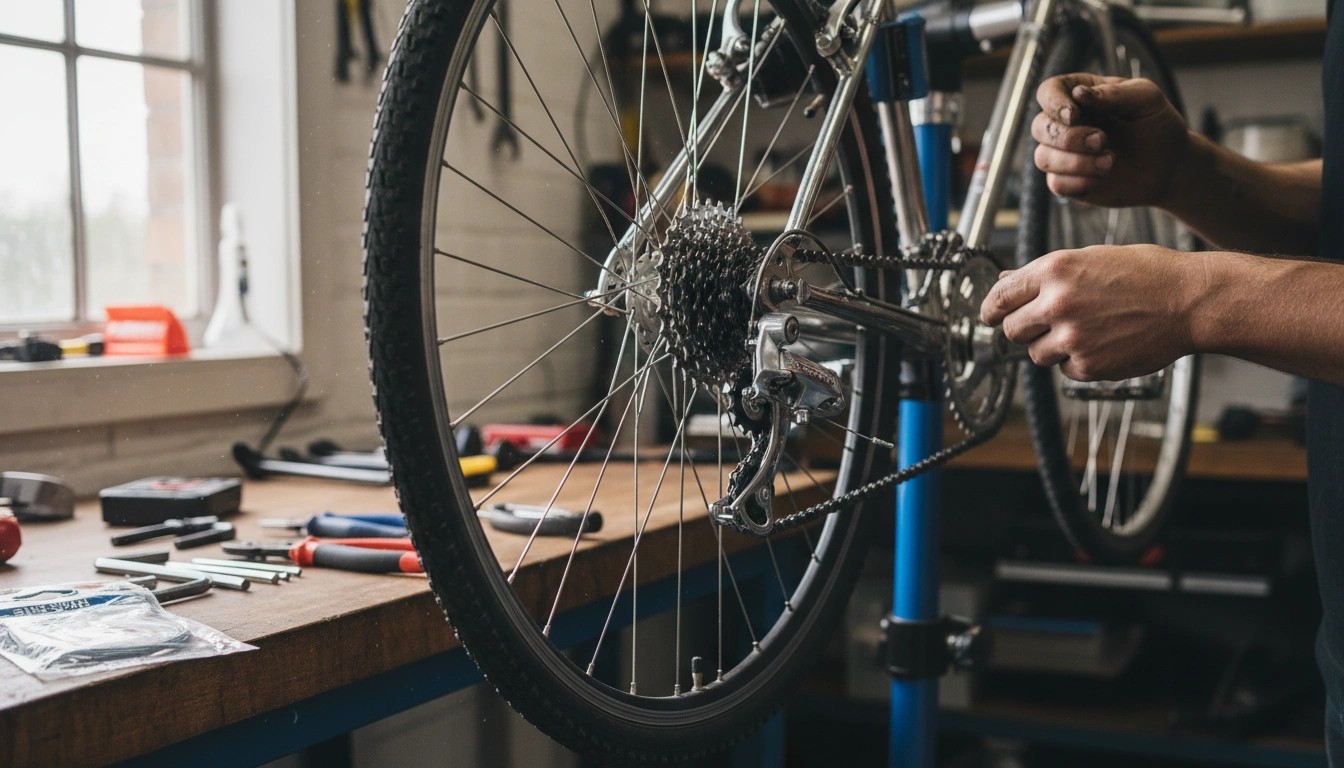
You’ve got a single-speed bike you love. Maybe it’s a beater commuter, maybe it’s a hand-me-down cruiser. It’s solid, simple – but that hill on the way home is slowly killing you. So the question hits: can you just… add gears to this thing?
Short answer: yes, usually. But “adding gears” isn’t one simple job. It depends on your frame, your budget, and how much you want to get into the weeds of bike mechanics. Some conversions are weekend projects. Others need a bike shop involved.
This guide walks through the three main ways to add gears, what each one costs, and how to figure out if your bike can even handle the conversion in the first place.
Can You Add Gears to a Single Speed Bike?
Yes – most of the time. The main thing that determines whether a conversion is possible is your frame’s rear dropout spacing. Older or classic single-speed bikes often have 120mm or 126mm spacing, while many modern single-speeds are built at 130mm or 135mm. Most geared drivetrains need 130mm or 135mm. That gap can sometimes be bridged, sometimes not.
Beyond spacing, you need a frame that accepts a derailleur hanger (or has one built in), a rear wheel hub that supports a cassette or freewheel, and enough clearance for the larger chainring and rear cogs. If you have a standard single-speed with horizontal dropouts, your options open up quite a bit. Vertical dropouts make things trickier but not impossible.
The other honest thing to say: sometimes the cost of conversion gets close to the cost of just buying a used geared bike. That doesn’t mean it’s not worth doing – sometimes the frame has sentimental value, or you just want to learn how this stuff works. But go in with eyes open on the numbers.
3 Ways to Add Gears to a Bike
Derailleur Conversion (Most Common)
This is the classic route. You swap out the rear wheel for one with a cassette hub, add a rear derailleur, replace the crankset or chainring, run new cables and housing, and install a shifter.
A basic 7-speed conversion using entry-level parts like Shimano Tourney components can run $80-150 in parts if you’re doing it yourself. (Note: Shimano Claris is an 8-speed groupset – for a 7-speed build, Tourney is the right entry-level choice.) A full groupset with higher-quality components gets more expensive – see the Shimano groupset comparison to understand where the tiers sit. Add $50-100 for labor if you take it to a shop.
You’ll want a good multi-tool and a chain tool if you’re tackling this yourself.
Cost: $80-250 in parts + $50-100 labor
Difficulty: Medium
Pros: Wide gear range, lightweight, familiar system
Cons: Requires frame compatibility, more maintenance
Internal Gear Hub (Low Maintenance Option)
An internal gear hub puts all the gears inside the rear hub. No derailleur, no exposed cassette. Just a clean-looking wheel and a twist shifter on the bars. Great for commuters who don’t want to think about maintenance.
A Shimano internal gear hub starts around $80-120 for a basic 3-speed Nexus and goes up to $300+ for the 11-speed Alfine.
Cost: $150-400 in parts + $60-120 labor
Difficulty: Medium
Pros: Very low maintenance, clean look, shift while stopped
Cons: Higher cost, heavier, limited gear range
Cold Setting the Frame (For Older Frames)
Cold setting is gently bending a steel frame’s rear dropouts wider to accommodate a wider hub. It’s a prerequisite step when your frame is too narrow for a geared hub.
Only works on steel frames. Aluminum and carbon will crack. A shop will charge $20-40.
Cost: $20-40
Difficulty: Low (at a shop)
Pros: Enables other conversions
Cons: Steel only
Cost Comparison Table
| Method | Parts Cost | Labor Cost | Difficulty | Best For |
|---|---|---|---|---|
| Derailleur Conversion | $80-250 | $50-100 | Medium | Wide gear range, lighter build |
| Internal Gear Hub | $150-400 | $60-120 | Medium | Commuters, low-maintenance |
| Cold Setting Frame | $0 | $20-40 | Low (pro) | Prerequisite for narrow steel frames |
A full bike derailleur set from Amazon can get you started for less if you go with a budget brand.
Frame Compatibility: What to Check First
This is the part that saves you from wasting money. Before buying anything, measure your rear dropout spacing.
| Frame Type | Typical OLD | Target OLD (Geared) | Cold Set Needed? |
|---|---|---|---|
| Single-speed / fixed gear | 120-135mm (varies) | 130-135mm | Only if under 130mm, steel only |
| Older road bike | 126mm | 130mm | Often yes |
| Modern road frame | 130mm | 130mm | No |
| Mountain / hybrid | 135mm | 135mm | No |
Also check: Dropout style (vertical vs horizontal), Derailleur hanger (needed for derailleur mount), Frame material (steel can be cold-set, aluminum/carbon cannot), and Bottom bracket compatibility with new cranksets.
Do You Actually Need Gears?
Genuinely – not everyone does. If your routes are flat, you ride short distances, and you like simplicity, single-speed is probably fine.
Gears genuinely help if you’re dealing with real hills, riding long distances, hauling loads, or want to ride faster. If that hill is making you dread the ride, gears solve that.
Sometimes the smarter move is selling the single-speed and buying a used geared bike that’s already set up right. If you’re on a fixed gear specifically, keep in mind that converting changes the whole character of the bike – some people love the fixie feel for a reason.
Frequently Asked Questions
Can you add gears to any bike?
Not any bike, but most steel-framed single-speeds can be converted. The main limits are frame material and dropout design. Aluminum and carbon frames can’t be cold-set to wider spacing.
How much does it cost to add gears to a bike?
A basic 7-speed derailleur conversion runs $130-350 all-in. An internal gear hub conversion is typically $210-520. Cold-setting a steel frame adds $20-40.
Is it worth converting a single-speed to gears?
It depends on the bike and how you ride. If the frame is solid and hills are making rides unpleasant, it’s worth it. If the bike cost $150 and conversion runs $200+, you’re probably better buying a used geared bike.
Can I add gears without replacing the rear wheel?
Usually not. Single-speed rear wheels don’t accept cassettes. You’ll need a new rear wheel with a cassette hub or internal gear hub.
Do I need to replace the chain when adding gears?
Yes. Single-speed chains are wider (1/8″) than multi-speed chains (3/32″). You’ll need a new chain sized for your drivetrain. Understanding derailleur chain maintenance helps once gears are on.
🚲 Free: The Smart Bike Buyer’s Cheat Sheet
Get our 2-page PDF - budget tiers, the components that actually matter, and a 12-point used-bike inspection. We'll email you the download link. No spam, unsubscribe anytime.
By subscribing you agree to our Privacy Policy.
