
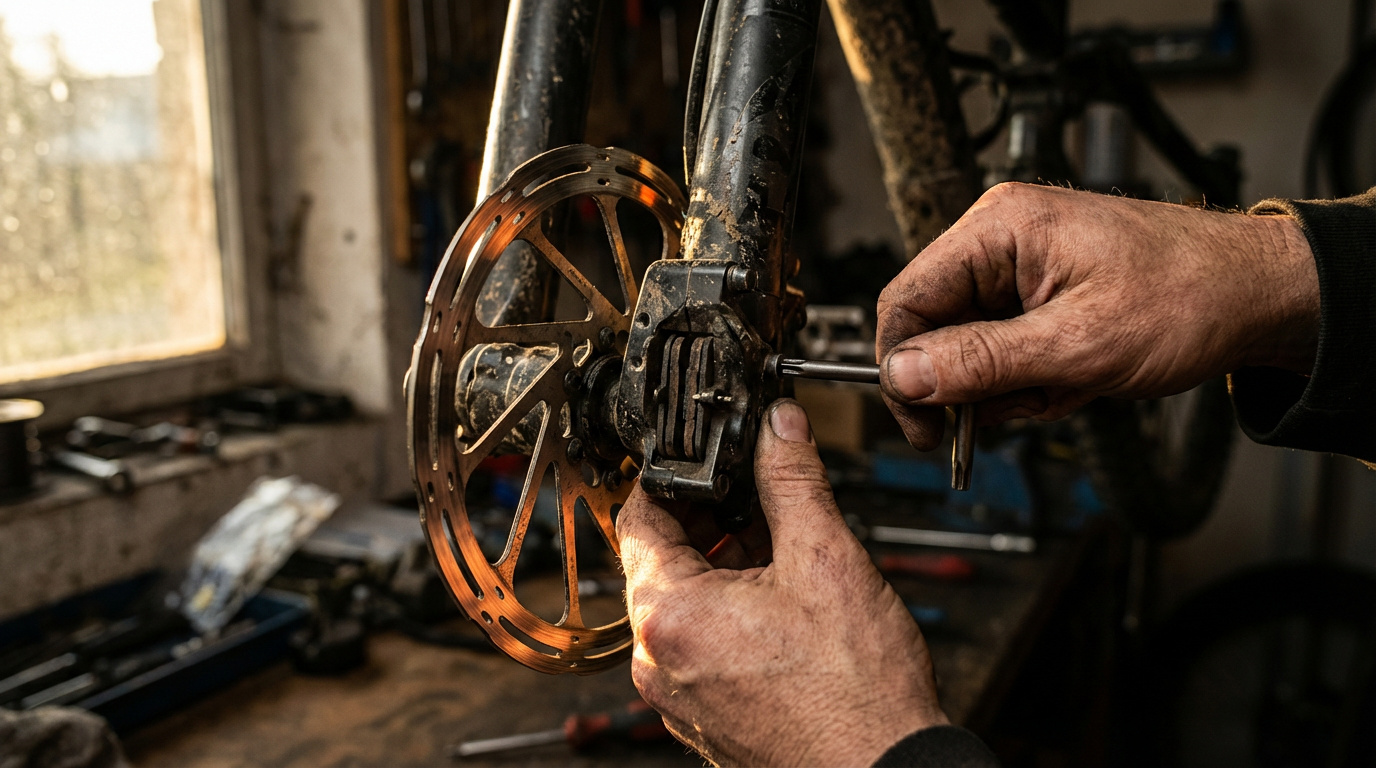
You know that shrieking sound your disc brakes make every time you squeeze the lever? The kind that makes your riding buddies wince and your neighbors close their windows? That is almost always fixable in 15 minutes with basic tools you probably already own. This guide covers both how to adjust bike disc brakes properly AND how to kill that squeal for good.
How Disc Brakes Work: Mechanical vs Hydraulic
Understanding the basics makes the adjustment process click instantly – and helps you figure out which type you have before you grab any tools.
Disc brakes work by clamping brake pads onto a metal rotor (the shiny disc attached to your wheel hub). There are two types:
- Mechanical disc brakes use a cable to pull the caliper piston and squeeze the pads. You can see the cable running from the lever down to the caliper. These are easier to adjust and bleed-free.
- Hydraulic disc brakes use brake fluid instead of a cable. Squeezing the lever pushes fluid through a hose and actuates the pistons. They offer more power and self-adjust as pads wear, but require occasional brake fluid changes.
Both types use the same basic caliper alignment process covered below. For a deeper look at the differences, check out mechanical vs hydraulic disc brakes compared.
Tools You Need to Adjust Disc Brakes
You do not need a full workshop for this. Most of it you probably already have lying around the garage.
| Tool | What It is For | Notes |
|---|---|---|
| 2mm hex key (Allen wrench) | Adjusting pad reach on some mechanical calipers | Part of most hex key sets |
| 2.5mm hex key | Cable tension bolt on mechanical brakes | Common size |
| T25 Torx key | Caliper mounting bolts on most disc brakes | Most important tool here – T25 Torx wrench |
| Torque wrench | Final tightening to spec (6-8 Nm for Shimano) | Optional but smart – Park Tool TW-5.2 is the go-to |
| Isopropyl alcohol (90%+) | Cleaning rotors and calipers | Use before every adjustment |
| Brake-specific cleaner spray | Degreasing contaminated rotors | Finish Line disc brake cleaner works well |
| New brake pads (if needed) | Replacing worn or contaminated pads | our disc brake pad guide covers the top picks |
A torque wrench is technically optional but I have seen a lot of riders strip caliper bolts by overtightening by hand. If you want the right tool for the job, check out the best bike torque wrenches.
How to Adjust Bike Disc Brakes (Step-by-Step)
This is the core process – and the good news is it takes about 10 minutes once you have done it once.
- Spin the wheel and identify the rub. Lift the bike so the wheel spins freely. Give it a good spin and listen or watch. If the rotor is rubbing on one side of the caliper constantly, the caliper is off-center. If it only rubs in one spot per revolution, you may have a bent rotor (covered in the squeal section below).
- Clean the rotor first. Spray isopropyl alcohol on a clean cloth and wipe the rotor down. Never touch the rotor surface with bare hands after cleaning – skin oils contaminate it.
- Loosen the caliper mounting bolts. These are usually T25 Torx bolts. Do not remove them completely – just loosen until the caliper can slide side-to-side slightly. For most brakes, half a turn is enough.
- Squeeze the brake lever firmly and hold it. With the caliper bolts loose, squeeze the lever hard and keep holding it. This forces the pads to clamp onto the rotor and self-center the caliper around it.
- While still holding the lever, tighten the caliper bolts. Alternate between the two bolts – a few turns on each – until both are snug. Target torque is 6-8 Nm if you have a torque wrench. Release the lever.
- Test spin the wheel. It should spin freely with little to no rubbing. If there is still a slight rub in one specific spot, skip to step 7. If it rubs all the way around, repeat steps 3-5.
- Fine-tune a persistent rub. Look directly through the caliper slot from the front. You can see both pads. Loosen one caliper bolt at a time and gently nudge the caliper body until the rotor sits centered. Retighten as you go.
- Check pad wear. Look through the caliper slot at the pad thickness. If either pad is less than 1mm thick, they need replacing. Worn pads are a common cause of inconsistent braking and noise. See our best disc brake pads guide for replacements.
- Bed in new pads if you replaced them. Do 10-20 moderate stops from 15 mph, letting the brake cool between each one. This transfers pad material onto the rotor surface and improves bite. Skip this with used pads.
Still getting brake rub after following these steps? The issue might be in the caliper alignment from a different angle – this guide on fixing disc brake rub covers additional fixes for stubborn cases.
Why Are My Disc Brakes Squealing? (And How to Fix It)
Squealing is the number one disc brake complaint and there are five distinct causes – each with a different fix. Knowing which one you have saves you from wasting time and money.
1. Contaminated brake pads or rotor
This is the most common cause. Oil, chain lube, or brake fluid on the rotor or pad surface kills braking power and creates a horrible squeal. Fix: Clean the rotor thoroughly with isopropyl alcohol. If the pads are contaminated, try sanding the surface lightly with 120-grit sandpaper on a flat surface. If the squeal returns quickly, replace the pads – contamination usually soaks through resin pads and cannot be fully removed.
2. Bent or warped rotor
A rotor that is slightly bent will rub intermittently and often squeal on contact. You can usually see this by watching the rotor from the front as the wheel spins – look for a wobble. Fix: Use a rotor truing tool (or very carefully use an adjustable wrench on the rotor tabs) to gently bend it back. Small bends are easy to fix; big bends or cracks mean replacement. This is also what causes that recurring noise that comes and goes with wheel rotation.
3. Glazed brake pads
If pads overheat (from a long descent with constant braking) they can glaze over – the surface hardens and becomes smooth, which reduces grip and causes squealing. Fix: Sand the pad surface lightly in a circular pattern with 120-grit sandpaper until the surface looks matte again. Do not use fine-grit paper – you want a slightly rough surface. If they are heavily glazed or the compound looks melted, replace them.
4. Misaligned caliper
When one pad drags against the rotor even lightly, it heats up and squeals. Follow the caliper centering steps above. A properly centered caliper should have equal, minimal clearance on both sides of the rotor.
5. New pads not bedded in
Brand-new pads almost always squeal until properly bedded in. The pad compound has not yet transferred to the rotor surface. Fix: Follow the bedding-in procedure from step 9 above. This usually resolves new-pad squeal within one short ride. Wheel noise that is not coming from the brake pads themselves could be something else entirely – this guide on squeaky bike wheels covers the full diagnostic.
How to Adjust Shimano Hydraulic Disc Brakes Specifically
Shimano hydraulic brakes are on the majority of mid-to-high-end bikes sold today, and they have a couple of quirks worth knowing about before you start wrenching.
Caliper alignment: Same T25 Torx process as above. Shimano hydraulic calipers (BR-MT200, BR-M4100, BR-M6100 and up) all use the same centering method – loosen the two caliper bolts, squeeze the lever, retighten. The self-centering works extremely reliably on Shimano calipers because the pistons extend evenly from both sides.
Lever reach adjustment: Shimano levers have a reach adjust dial or bolt on the inside of the lever body. This controls how far the lever sits from the handlebar at rest. Turning it inward moves the lever closer to the bar – useful for smaller hands or if your fingers are not quite reaching the lever comfortably. On most Shimano levers it is a small flathead screw or a 2mm hex bolt behind the lever pivot.
Pad contact point adjustment: Higher-end Shimano levers (Deore XT, XTR, GRX) also have a free stroke adjust – this controls when in the lever pull the pads first contact the rotor. Tightening it reduces the dead travel before the brake bites. On XT, XTR, and GRX levers this is a tool-free dial at the top of the lever body – a small turn is usually all it takes to tune the feel significantly.
When alignment is not enough: If your Shimano hydraulic brakes feel spongy despite correct alignment, that is a bleeding issue, not an adjustment issue. See the next section for when to bleed vs. when to adjust.
When to Bleed Disc Brakes vs Adjust Them
A lot of riders confuse these two very different problems – and end up spending an hour bleeding brakes that just needed a quick re-center.
Use this decision rule:
- Adjust (centering/alignment) if: the brake rubs, pulls to one side, or makes contact noise but the lever feel is firm and consistent
- Bleed if: the lever feels spongy, goes to the bar under hard braking, or has inconsistent bite regardless of pad/rotor condition
- Replace pads/rotor if: braking power feels weak even with firm lever feel and correct alignment
Hydraulic brakes need bleeding roughly once a year under normal use, or any time the system is opened. Mineral oil systems (Shimano) and DOT fluid systems (SRAM, Magura) use different fluids – do not mix them. For full instructions on a brake fluid change, see our guide to changing bicycle brake fluid.
Common Disc Brake Adjustment Mistakes
These are the things I see most often go wrong – and they are all avoidable with 30 seconds of awareness.
- Touching the rotor with bare hands after cleaning. Skin oil re-contaminates in seconds. Hold the rotor by the edge tabs or use gloves.
- Overtightening caliper bolts. The correct torque is 6-8 Nm for most Shimano calipers. That feels lighter than you expect. Overtightening can warp the caliper mount or strip the bolt threads. Use a torque wrench – it is worth it, especially on carbon frames.
- Tightening both caliper bolts at once. Tighten alternately, a bit at a time, to keep the caliper centered. Torquing one fully before the other shifts the position.
- Skipping the bedding-in process. New pads that are not bedded in will squeal for weeks. Fifteen minutes of proper bedding saves you a month of frustration.
- Using WD-40 anywhere near brakes. WD-40 is a lubricant. On brake pads or rotors it causes catastrophic contamination and near-zero braking. Not less effective – near zero. Use only isopropyl alcohol or brake-specific cleaner.
- Ignoring pad wear. Worn pads are the root cause of more brake problems than anything else. If the pad compound is less than 1mm thick, replace before adjusting anything else.
Regular brake maintenance goes hand in hand with overall bike care – for the full picture on keeping your bike in shape, bicycle frame maintenance covers what to check and when. And if you are wondering what a full professional tune-up would cost vs doing it yourself, this breakdown of bike tune-up costs is useful.
Frequently Asked Questions
A few questions that come up constantly on this topic.
Why do my disc brakes squeal after rain?
Water temporarily reduces friction between the pad and rotor, causing a squeal or squeak for the first few brake applications. This is completely normal and usually clears up after 2-3 stops as the heat evaporates the water. If squealing persists in dry conditions, that is a different issue – check for contamination or glazing as described above.
How tight should disc brake caliper bolts be?
Most Shimano calipers specify 6-8 Nm for caliper mounting bolts – always check your specific caliper manual. This is lighter than it feels – if you are using a torque wrench for the first time, you will be surprised how little force that actually is. On carbon frames especially, never guess – use a torque wrench.
Can I use WD-40 on disc brakes?
No. Absolutely not. WD-40 is a water-displacing lubricant and it will contaminate your brake pads on contact, reducing braking power to near zero. It soaks into resin pads and cannot be fully removed – you will need new pads. Use only isopropyl alcohol (90%+) or brake-specific cleaner spray on rotors and calipers. Keep all lubricants at least 30cm away from brake components.
How often should I adjust disc brakes?
Check alignment whenever you hear rubbing or feel vibration. Most riders need a quick re-center a few times per season – typically after transport (airline travel and car racks often knock calipers out of alignment), after wheel removal and reinstallation, or after a crash. Pads typically last 500-2,000 km depending on riding conditions, with wet/muddy riding wearing them much faster.
Do I need to bed in new disc brake pads?
Yes, always. New pads need a bedding-in process to transfer pad material onto the rotor surface, which builds grip and eliminates that initial squeal. Do 10-20 moderate stops from 15 mph, letting the brakes cool between each. After bedding, the bite should feel noticeably stronger and more consistent. Skipping this step is why so many riders think new pads are bad when they are actually just not bedded in yet.
🚲 Free: The Smart Bike Buyer’s Cheat Sheet
Get our 2-page PDF - budget tiers, the components that actually matter, and a 12-point used-bike inspection. We'll email you the download link. No spam, unsubscribe anytime.
By subscribing you agree to our Privacy Policy.