
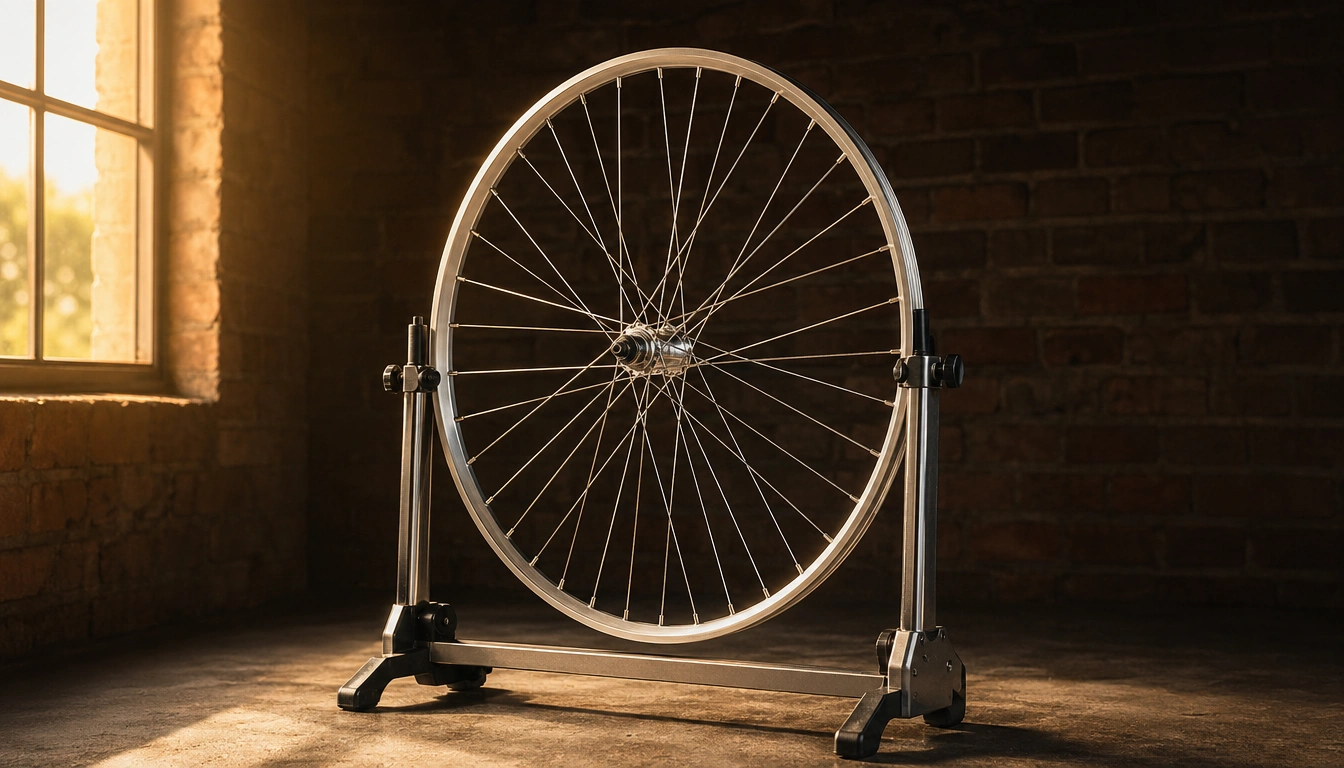
You hit a pothole, heard that familiar thud, and now your wheel is wobbling like it had a rough night. Brake rub, that rhythmic scraping sound as the rim pulses against the pad – you know something’s wrong. The good news is a bent bike wheel is one of the more fixable problems you can handle at home, with the right approach.
How to Tell if Your Bike Wheel Is Bent (Lateral vs Radial)
Before you grab a tool, you need to know what you’re actually dealing with. Not all bends are the same, and misreading the problem leads to wasted time and sometimes a worse wheel.
There are three types of wheel problems you’ll encounter:
- Lateral (side-to-side) wobble – the most common. The rim sweeps left and right as it spins. You’ll see it clearly if you hold a reference point (finger, zip tie, brake pad) steady and spin the wheel. The rim moves toward and away from that reference point.
- Radial (up-and-down) hop – the rim bounces vertically as it spins. The wheel looks egg-shaped when spinning. Less common but still fixable at home in mild cases.
- Taco bend – the wheel is folded like a taco shell. The rim is visibly warped into a curved shape when viewed from the side. This is not a truing job. This is a replacement job.
How to diagnose: Lift the bike off the ground, spin the wheel slowly, and watch from both the front (for lateral wobble) and from the side (for radial hop). Hold your thumb or a zip tie close to the rim as a gauge. Any movement over 2-3mm side to side, or any visible hop, means the wheel needs attention.
When to Fix vs Replace a Bent Bike Wheel
Not every bent wheel is worth fixing, and knowing when to stop tinkering and just replace can save you a lot of frustration (and money).
- Mild lateral wobble (under 3mm): True it at home. This is exactly what spoke adjustment is for.
- Moderate wobble (3-5mm): Still fixable but takes more patience. If spokes feel loose or one side is under-tensioned, bring tension up first, then true.
- Severe wobble (over 5mm) or taco: Replace the rim. You can relace it onto the same hub if the hub is undamaged, or buy a complete new wheel.
- Cracked rim: Replace immediately. A cracked rim under load is a safety hazard. No amount of truing fixes metal fatigue cracks.
- Flat spot (rim dented inward): Usually irreparable. The aluminum deforms permanently. Replace.
I’ve seen riders true wheels with 8mm wobbles into something rideable, but it never stays true for long. The rim has been stressed. If you’re spending an hour and still can’t get it under 2mm, that wheel is telling you something.
Tools You Need to True a Bike Wheel
You don’t need a full workshop for this. Most of what you need costs under $20, and one tool is literally free.
| Tool | Required? | Notes |
|---|---|---|
| Spoke wrench | Yes – essential | Must match your nipple size: 3.23mm, 3.30mm, or 3.45mm. Park Tool SW-7.2 covers all three sizes in one tool. |
| Truing stand | Strongly recommended | The Park Tool TS-25 is the gold standard. Or use the zip-tie hack below for free. |
| Dish stick / wheel dish tool | Optional | For checking if the rim is centered between the dropouts. Important on rear wheels. |
| Spoke tension meter | Optional | The Park Tool TM-1 takes the guesswork out of even tensioning. Worth it if you true wheels regularly. |
| Zip tie | Free alternative | Zip-tie to the fork or chainstay, bend tip toward rim as a reference gauge. |
Important: Spoke wrench sizing matters a lot. Use the wrong size and you’ll round off brass nipples, which makes them very hard to turn. The Park Tool SW-7.2 is a three-sided wrench that fits all standard nipple sizes – the safest starting point.
If you’re doing a lot of maintenance work, having a quality cycling multi-tool and a bike torque wrench in your kit covers most home mechanic jobs.
How to True a Bike Wheel (Lateral Truing – Side-to-Side Wobble)
This is the core skill. Lateral truing sounds complicated until you understand the logic: spokes on the right side pull the rim right, spokes on the left side pull the rim left. You’re just balancing those pulls.
Follow these steps:
- Remove the tire and tube (optional but recommended). You don’t have to, but it makes spinning the wheel easier and lets you feel spoke tension without tire resistance. For small corrections, you can skip this.
- Mount the wheel in a truing stand, or use your bike frame as the reference. If using the bike, flip it upside down. The brake pads or a zip-tie attached to the fork leg can serve as your reference point.
- Spin the wheel slowly and find where the wobble is worst. Watch where the rim gets closest to your reference point. That’s the problem area. Mark it with a piece of tape or remember the valve position as a landmark.
- Identify which side the rim pulls toward at the worst point. If the rim pulls left at the marked spot, you’ll tighten the spokes on the RIGHT side of that area (or loosen spokes on the left side).
- Turn the nipple 1/4 turn at a time. Tightening a nipple = turn clockwise when viewed from the nipple end (the outside of the rim). Loosen = counterclockwise. Start with 1/4 turn. Don’t overtighten – more on this in the mistakes section.
- Spin and re-evaluate. The wobble should be smaller. If it’s bigger, you turned the wrong direction.
- Work in small increments, spread over 2-3 spokes. Don’t dump all the correction into one spoke. Spread the adjustment across the 3 spokes nearest the wobble for smoother tension distribution.
- Repeat until wobble is under 1mm. Under 1mm is excellent. Under 2mm is fine for trail riding and commuting.
This process feels slow at first. After a few wheels it becomes intuitive – you’ll feel the tension changes and know where to look next without thinking about it.
If your wheel has disc brakes, small wobbles can cause brake rub too. After truing, check out this guide on how to adjust disc brakes on a bike to eliminate any residual rub.
How to Fix a Radial Bend (Up-and-Down Hop)
Radial hops are less common but often show up after a solid impact – hitting a curb square-on, or landing hard from a jump. The fix is similar to lateral truing but you’re adjusting tension evenly on both sides.
Here’s the approach:
- Spin the wheel and identify the “high spot” – where the rim bulges outward (creates the hop). This is where tension is too low.
- Find the 2-3 spokes in that section of the rim.
- Tighten both the left and right spokes in that section equally – same number of turns on each side. This pulls the rim inward (toward the hub) to eliminate the hop.
- Work in 1/4 turn increments. Recheck after each round.
After tightening the low-tension spokes, check if you’ve introduced any lateral wobble. Radial truing almost always affects lateral true as well, so a quick lateral check after each round of adjustments is smart practice.
If you’re also dealing with squeaky wheels alongside the wobble, it might be a spoke tension issue compounding the noise. Check our guide on squeaky bike wheel fixes once you’ve got the wobble sorted.
How to Fix a Severely Bent Rim (Taco Wheel)
A taco wheel is when the rim has folded into a visible curve – named because it looks like a taco shell when you view it face-on. This is not a precision spoke adjustment job. You’re dealing with a structurally compromised rim.
There is one last-resort technique called the knee press:
- Remove the wheel from the bike.
- Hold the wheel on both sides of the taco curve with both hands, on the rim.
- Place your knee at the apex of the curve (the deepest part of the taco).
- Apply firm, even pressure to push the rim back toward flat.
Honestly? This rarely gives you a usable wheel. You might get it flat enough to limp home. But the rim has been permanently deformed – the metal structure is compromised at the bend point. Even if it looks straight, it’s weaker there. I’d ride a taco-pressed wheel to get home, not rely on it for actual riding.
If the wheel is genuinely taco’d, the call is clear: replace it. If you’re considering the full cost picture, this guide on bike tune-up costs breaks down what a shop wheel replacement typically runs vs DIY.
How to True a Wheel Without a Truing Stand
You don’t need to buy a truing stand to true a wheel. The bike frame itself is a surprisingly effective reference – you just need a consistent point of comparison.
Method 1: Zip-tie gauge (recommended)
- Flip the bike upside down so it rests on the handlebars and saddle.
- Attach a zip tie to the fork leg (front wheel) or chainstay (rear wheel).
- Bend the pointed end of the zip tie toward the rim, leaving about 1mm of clearance.
- Spin the wheel. Where the rim gets closest to (or touches) the zip tie is your worst wobble point.
- Adjust spokes as described above, moving the rim away from the zip tie.
- Gradually trim the zip tie shorter as the wheel improves, narrowing your tolerance.
Method 2: Brake pads as reference
If you have rim brakes, the brake pads are already close to the rim and in a fixed position. Loosen the brake caliper slightly so pads just barely don’t contact the rim. Spin and watch which side the rim contacts first. That’s your adjustment zone. This method works well for quick fixes but doesn’t give you the fine control of a zip tie.
Neither method beats a proper truing stand for precision, but both work well for getting a wheel road-worthy at home. For related frame and component maintenance, the bicycle frame maintenance guide covers the full picture of keeping your bike in shape.
How to Adjust Spoke Tension (Tightening Loose Spokes)
Truing and tensioning are related but different jobs. Truing is about making the rim run straight. Tensioning is about making sure all the spokes share the load evenly. A wheel can be perfectly true but have wildly uneven tension – and that’s a wheel that won’t stay true for long.
How to find loose spokes:
- Squeeze pairs: Grab two adjacent spokes on the same side and squeeze. They should feel roughly equal in stiffness. A spoke that collapses easily compared to its neighbors is loose.
- Ping test: Flick each spoke with a finger. Tight spokes ring with a higher note. Loose spokes thud. You’re listening for spokes that sound noticeably lower than the rest.
- Tension meter: The Park Tool TM-1 gives you actual tension readings in Kgf, so you can match all spokes to a target value (typically 100-120 Kgf for rear drive-side spokes).
How to bring up loose spokes:
- Identify all loose spokes using the methods above.
- Tighten each loose spoke in 1/4 turn increments. Don’t correct all at once – bring them up gradually.
- After each round of tightening, re-check lateral and radial true. Tensioning inevitably affects where the rim sits.
- Once all spokes feel roughly equal, do a final lateral true pass to clean up any movement introduced by the tensioning.
- Stress-relieve the wheel: grip pairs of spokes and squeeze firmly around the whole wheel, then re-true. This settles the nipples and stabilizes tension.
If you’ve recently patched a flat or removed the tire for spoke work, check out our how to patch a bike tire guide before you re-seat the tube. And if the tire keeps going soft despite no puncture, slowly deflating bike tire causes covers what else might be going on.
Common Wheel Truing Mistakes
Most wheel truing problems come down to a few repeating errors. Knowing them in advance will save you a lot of frustration on your first attempt.
1. Over-tightening spokes
This is the most common mistake. One too-tight spoke pulls the rim hard in one direction and creates a new wobble. If you over-tighten, you’ll spend twice as long fixing the correction as you did making the original adjustment. Rule of thumb: 1/4 turn at a time, always. Sometimes 1/8 turn when you’re close.
2. Twisting the nipple instead of turning it
If your spoke wrench slips or doesn’t fully engage the nipple flats, you’re rounding the nipple. Rounded nipples are very hard to turn and can get stuck. Make sure the wrench fits snugly before applying torque. This is why spoke wrench sizing matters – a sloppy fit ruins nipples fast.
3. Ignoring dish on rear wheels
Rear wheels are not centered between the dropouts – they’re offset toward the drive side to clear the cassette. A wheel can be perfectly true but badly dished, which means it sits to one side in the frame. If you’ve done major spoke work on a rear wheel, check dish with a dish tool or by flipping the wheel 180 degrees in the frame and seeing if the gap to each dropout changes.
4. Fixing lateral wobble without checking radial
A wheel can look laterally true but still have a radial hop. Check both planes every time before calling a wheel done.
5. Skipping the stress-relief step
After truing, new spoke tension isn’t fully settled. Squeeze spokes in pairs, apply some weight to the wheel, then re-check true. Skipping this step means the wheel goes out of true after the first hard ride.
For disc brake setups, a well-trued wheel also helps with brake alignment. If you’re still getting rubbing after truing, our how to adjust bike brakes when rubbing guide covers the full brake adjustment process.
Frequently Asked Questions
Can I ride a bike with a slightly bent wheel?
For small wobbles (under 2mm), yes – it’s not ideal but it won’t cause immediate problems. The concern is that a slightly bent wheel gets worse over time as spoke tension distributes unevenly with each ride. Fix it soon rather than riding on it indefinitely.
How much does it cost to true a wheel at a bike shop?
Most shops charge $15-$30 for a basic wheel true. A full tension adjustment with stress-relieving and dish check can run $30-$50. It’s worth doing yourself once you’ve seen how it works – the skill saves you money on every wheel you own going forward.
What size spoke wrench do I need?
Most modern bikes use 3.23mm (black), 3.30mm (red), or 3.45mm (green) nipples in the Park Tool color code system. If you don’t know which you have, the Park Tool SW-7.2 is a three-headed wrench that fits all three sizes. Try each head – the one that grips snugly without slipping is your size.
How long does it take to true a wheel?
For a mild wobble with an experienced hand: 10-20 minutes. For a beginner learning the process: 45-90 minutes for the first wheel. After a few sessions it becomes much faster. Patience matters more than speed – slow corrections beat fast over-tightening every time.
Can a bent rim be straightened?
Mild lateral wobble – absolutely, that’s exactly what spoke truing does. Radial hops – yes, in mild cases. A severely bent or taco’d rim – no, not reliably. A cracked rim cannot be safely repaired at all. The general rule: if you can’t see the bend with the naked eye when the wheel is stationary, it’s fixable. If the rim is visibly deformed when you look at it stopped, it likely needs replacing.
🚲 Free: The Smart Bike Buyer’s Cheat Sheet
Get our 2-page PDF - budget tiers, the components that actually matter, and a 12-point used-bike inspection. We'll email you the download link. No spam, unsubscribe anytime.
By subscribing you agree to our Privacy Policy.