
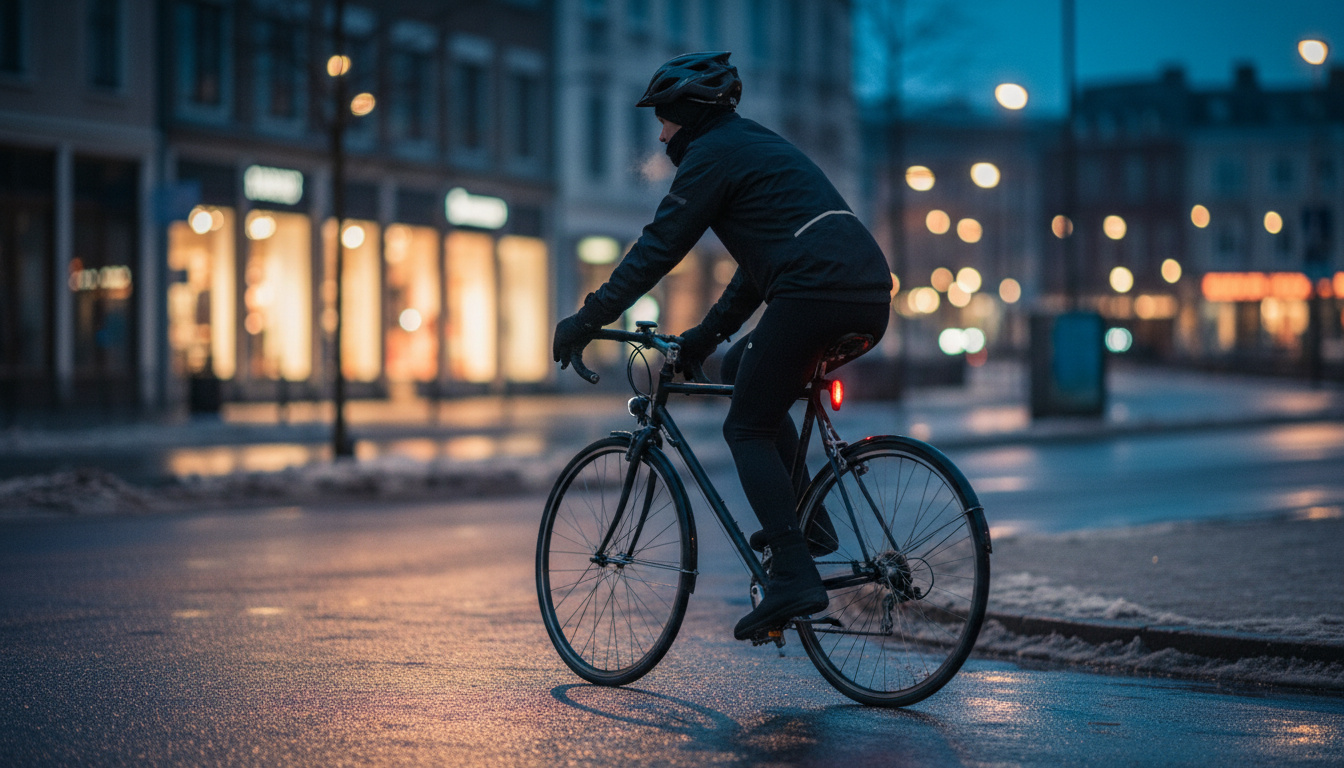
The first properly cold morning of the year is a lie detector. You walk out in your summer kit, feel brave for about forty seconds, and then your fingers stop answering your calls.
Good news: winter riding mostly comes down to a few smart layers, warm hands and feet, and lights that make drivers see you. This guide covers all of it, from what to wear at each temperature to bike prep, a short fix for a runny nose, and the honest “maybe I’ll ride indoors today” option. The 12 picks below are chosen from what each listing says and what the product is built for, so read the details and size charts before you buy.
Some links on this page are affiliate links. If you buy through them we may earn a small commission, at no extra cost to you.
Let’s get into it.
Key Takeaways
Short on time? Here is the cheat sheet, no frostbite required.
- Dress in three layers: a wicking base layer like the Castelli merino base layer, an optional warm mid layer, and a windproof outer layer like the ROCKBROS jacket.
- Hands and feet quit first. Winter gloves such as the INBIKE work for cold days, lobster gloves like the Pearl Izumi AmFIB Lobster Evo for the coldest, and neoprene shoe covers over wool socks keep toes in the game.
- Start a little chilly. You will warm up within minutes, and sweating in too many layers is how you end up cold later.
- Lights are about being seen first. A set like the Ascher light set works on lit streets, but dark roads need a much brighter light to see by.
- Prep the bike too: wet lube, fenders, and studded tires only if you really meet ice. Rinse off road salt after salty rides.
- Some days, ride indoors. A trainer stand turns your own bike into a winter workout machine.
What to Wear by Temperature
This is the part everyone wants first: what do I actually put on when I look at the weather app? Use the chart as a starting point, then tweak it for your own body.
| Temperature | Body | Hands and feet | Head |
|---|---|---|---|
| Above 10°C (50°F) | Light base layer plus a thin jacket or wind vest | Light full-finger gloves, regular socks | Thin cap or headband |
| 0 to 10°C (32 to 50°F) | Merino or thermal base layer, warm windproof jacket, thermal tights | Winter gloves, wool socks, shoe covers | Skull cap under the helmet |
| Below 0°C (32°F) | Base layer, mid layer, windproof shell, thermal bib tights | Lobster gloves, wool socks, neoprene shoe covers | Balaclava or skull cap, plus a neck warmer |
Think of it as a rule of thumb, not a law. Some riders run hot, some run cold, and wind, rain and how hard you ride all change the answer. A good test is to feel a little chilly in the first few minutes. If you are comfortable standing in the driveway, you will probably be sweating by the end of the block.
Winter Cycling Gear: Our Quick Picks
Here is the whole shopping list at a glance, from the layer against your skin to the lube on your chain. Each pick has a longer write-up further down.
| Castelli Men’s Merino Seamless Baselayer |  |
Best Base Layer | Fabric: Merino wool blend | Sleeves: Long | Use: Base or mid layer | VIEW LATEST PRICE | Read Our Analysis |
| ROCKBROS Men’s Winter Cycling Jacket |  |
Best Windproof Jacket | Fabric: Thermal fleece, windproof | Visibility: Reflective details | Pockets: 3 front, 1 rear | VIEW LATEST PRICE | Read Our Analysis |
| baleaf Men 4D Padded Thermal Cycling Bib Tights |  |
Best Winter Bib Tights | Style: Bib tights | Padding: 4D padded | Pockets: 2 side, 3 rear | VIEW LATEST PRICE | Read Our Analysis |
| INBIKE Winter Cycling Gloves |  |
Best Everyday Gloves | Outer: Windproof shell | Lining: Fleece | Touchscreen: Yes | VIEW LATEST PRICE | Read Our Analysis |
| Pearl Izumi AmFIB Lobster Evo Gloves |  |
Best for Freezing Hands | Style: Lobster glove | Insulation: PrimaLoft Gold | Touchscreen: Yes | VIEW LATEST PRICE | Read Our Analysis |
| GripGrab Ride Winter Neoprene Overshoes |  |
Best Shoe Covers | Material: 4 mm neoprene | Closure: Hook-and-loop | Fits: Road shoes | VIEW LATEST PRICE | Read Our Analysis |
| DEFEET Woolie Boolie Merino Wool Socks (2-Pack) |  |
Best Wool Socks | Fabric: Merino wool blend | Height: 4 inch quarter | Pack: 2 pairs | VIEW LATEST PRICE | Read Our Analysis |
| ROCKBROS Windproof Thermal Balaclava |  |
Best Balaclava | Lining: Fleece | Coverage: Head, face, neck | Under helmet: Yes | VIEW LATEST PRICE | Read Our Analysis |
| Ascher USB Rechargeable Bike Light Set |  |
Best Light Set | Includes: Headlight and taillight | Charging: USB | Water resistance: IPX4 | VIEW LATEST PRICE | Read Our Analysis |
| Schwalbe Winter Studded Tire (700 x 30C) |  |
Best for Ice | Type: Studded | Size: 700 x 30C | Use: Snow and ice | VIEW LATEST PRICE | Read Our Analysis |
| SKS Bluemels B45 Fender Set for 700c Wheels |  |
Best Fenders | Coverage: Full length, front and rear | Fits: 700c, 28 to 37 mm tires | Mounting: Frame eyelets | VIEW LATEST PRICE | Read Our Analysis |
| Finish Line Wet Bike Chain Lube |  |
Best Wet Lube | Type: Wet-style lube | Size: 4 fl oz | Made for: Rain and mud | VIEW LATEST PRICE | Read Our Analysis |
Layering 101: Base, Mid and Shell
Layers usually beat one giant puffy coat, because you can peel them off when you warm up. Here is the simple three-part recipe.
Base Layer: Next to Your Skin
The base layer’s job is to move sweat away from your skin so you do not turn into a damp, shivering mess when you stop at a light. Merino wool and synthetic fabrics are the usual choices. Cotton is the villain here, because it soaks up sweat and holds on to it. The Castelli Men’s Merino Seamless Baselayer is a good example of a merino option.
Mid Layer: The Warm Bit
A fleece or thermal jersey adds warmth. In milder cold you can skip it, and in deep cold you will want it. Some jackets, like the ROCKBROS Men’s Winter Cycling Jacket, blend a fleece lining with wind protection, so one piece does both jobs.
Shell: Wind and Wet Protection
The outer layer blocks wind, which pulls heat off you quickly when you are moving. Look for a snug, bike-friendly cut, zippers you can open to vent, and reflective details. A water-resistant jacket handles light drizzle, but long rides in heavy rain call for a real waterproof shell.
Legs
Thermal tights or bib tights, like the baleaf Men 4D Padded Thermal Cycling Bib Tights, keep your knees warm, and knees do not enjoy being cold.
Hands, Feet and Head
Your core can feel fine while your fingers, toes and ears are filing complaints. These are the spots worth spending a little extra on.
Hands: Gloves or Lobster Gloves?
For cold days, a good winter glove such as the INBIKE Winter Cycling Gloves is a solid start. When it drops below freezing, lobster gloves like the Pearl Izumi AmFIB Lobster Evo Gloves are worth a look. Pearl Izumi pitches them for sub-freezing winter rides: the ring and little fingers stay grouped for warmth, while the index and middle fingers are split so you can still work the brake levers. Whatever you choose, make sure you can squeeze both levers firmly. Gloves that are too tight can squeeze your hand and make it colder, so leave a little room.
Feet: Wool Socks and Shoe Covers
Wool socks like the DEFEET Woolie Boolie Merino Wool Socks (2-Pack) plus neoprene covers like the GripGrab Ride Winter Neoprene Overshoes are a classic winter combo. The covers block wind and spray, which is what chills your toes, and wool keeps more of its warmth than cotton when it gets a bit damp. If covers are not enough, dedicated winter shoes are the next step, and we have a guide to the best winter cycling shoes.
Head: Caps and Balaclavas
A cold head and cold ears can ruin a ride fast. A thin skull cap under your helmet is enough for most cold days. For the coldest rides, a balaclava like the ROCKBROS Windproof Thermal Balaclava covers your face and neck as well. We break down the options in our guides to the cycling cap under a helmet and the best headband for cycling.
Before you ride, put your helmet on over the cap and check that it still sits level and snug, and adjust the straps if it does not. Also remember that a helmet should be replaced after a crash or hard impact, even if it looks fine, because the foam can be damaged where you cannot see it. Our protective cycling gear guide has the details.
Lights and Visibility for Short Days
In winter, a big chunk of your ride happens in the dark, often right when traffic is at its worst. Good lights are cheap insurance.
To Be Seen vs. To See
These are two different jobs. On lit city streets, your lights are mostly there so drivers notice you, and even a modest set works. On dark roads or trails, you need a much brighter front light so you can actually see the surface. A set like the Ascher USB Rechargeable Bike Light Set is a solid commuter starter, and anything beyond that depends on how dark your route is.
Front, Rear and the Law
Run a white light on the front and a red light on the back. Typical US state law asks for a white front light and a red rear reflector at night, and many places let a red rear light count in place of the reflector. Rules vary by state and city, so check your local laws. Charge your lights before every ride, because cold weather can shorten battery run time. Keeping a backup light in your bag is a cheap fix.
Be Easy to Spot
Reflective strips on parts that move, like your ankles and knees, help drivers recognize you as a person on a bike, not just a light. Our guide to reflective bicycle gear covers vests, bands and more. If you want a light that sits on your head, see our roundup of helmets with built-in rechargeable lights. And for proper off-road night riding, check out the best lights for mountain biking at night.
Get Your Bike Ready for Winter
You are not the only one who suffers in the cold. Your bike hates slush, salt and grit too, and a little prep goes a long way.
Tires: Regular or Studded?
Regular tires are fine on clear pavement, wet or dry. Studded tires like the Schwalbe Winter Studded Tire (700 x 30C) are built for ice and packed snow, and they are mainly worth it if you regularly meet ice on your route. They tend to be noisier and slower on clear pavement. If you ride deep snow often, a fat bike is built for it, and our pros and cons of fat tire bikes breaks that down.
Fenders
Fenders cut down the slush and dirty water that spray up onto your back, your feet and your drivetrain. Full-length sets like the SKS Bluemels B45 Fender Set bolt to eyelets on the frame and fork, so check that your bike has them and that the set matches your tire width and frame clearance.
Lube: Go Wet
Winter chains need lube that stays on in wet conditions. Wet lube, like the Finish Line Wet Bike Chain Lube, is made for that. Wipe your chain clean before you re-lube, and wipe off the extra so it does not collect grit.
Cleaning Road Salt Off Your Bike
Road salt is hard on metal parts. After a salty ride, rinse the bike with plain water from a hose or bucket, dry it with a rag, then wipe and re-lube the chain. A gentle rinse beats blasting water at your bearings. It does not take long, and your drivetrain will thank you.
Why Your Nose Runs in the Cold
Chances are you are not sick, and you are not alone. A leaky nose is one of the least glamorous parts of winter riding, so here is the short version.
Cold, dry air sets off a reflex in the lining of your nose that makes extra mucus. It is common, sometimes called cold-induced rhinitis, and usually harmless. A few things help: carry a tissue or soft cloth in a jersey pocket, wear a balaclava or neck warmer to warm the air you breathe, and keep a hand free for a quick wipe at stoplights.
The classic “snot rocket” is a thing riders do, but only when no one is nearby and you are not upwind of anyone. If a runny nose comes with other symptoms or won’t go away, check in with a doctor.
Cold and Ice Safety
Winter riding is great until it isn’t, so here are the basics for staying upright and staying warm. This is general guidance, not medical advice.
Riding on Ice and Snow
- Slow down, and brake earlier and more gently than usual. Hard braking and sharp turns are the quickest way to lose grip.
- Black ice is thin and hard to see. Bridges and overpasses freeze first, and shaded spots stay icy longer, so be extra careful there.
- Cross wet metal, like manhole covers and painted lines, upright and straight, without braking or turning. Cross rails at a right angle.
- Keep your bike upright and your steering smooth. Give yourself extra distance from cars, since they need longer to stop too.
- Snowbanks narrow the road, so expect less room and watch for drivers who do not expect you.
Keeping Yourself Warm
- Do not overdress. Sweat is what chills you once you stop.
- Carry a spare layer for stops, because standing around in sweaty clothes gets cold fast.
- Bring a charged phone and tell someone your route on longer rides, since cold weather can drain batteries quickly.
- Keep drinking water, even when you do not feel thirsty.
If you cannot stop shivering, feel confused or clumsy, or your fingers or toes go numb or the skin looks pale, grey or waxy, head somewhere warm and take it seriously. Hypothermia and frostbite are medical problems, so do not ignore them, and get medical help if you are worried.
More Details on Our Top Picks
Castelli Men’s Merino Seamless Baselayer
Nothing makes or breaks a cold ride like the layer touching your skin. This Castelli merino base layer is the quiet one doing most of the work.
The listing calls it a merino wool blend with a seamless, close-to-the-body cut and a low collar, so it slides under a jersey or jacket without bunching. Castelli says it works as a base layer or a mid layer, and that it suits cold rides of roughly -4 to 10°C (25 to 50°F).
One sizing note from the maker: Castelli cuts run snug, and they suggest sizing up if you want a looser feel or you land between sizes. It’s machine washable, and you hang it to dry. A good pick if you want one dependable layer under everything else.
- Brand: Castelli
- Fabric: Merino wool blend
- Sleeves: Long
- Construction: Seamless
- Collar: Low
- Fit: Close to the body
- Use: Base layer or mid layer
- Care: Machine wash, hang dry
ROCKBROS Men’s Winter Cycling Jacket
Wind is what turns a chilly day into a miserable one, and this jacket exists to say no to it.
The listing describes thermal fleece with a windproof fabric, so it can do the job of a mid layer and a shell in one piece. It also lists breathable holes on the shoulders and back, reflective details for night riding, three zippered front pockets and a big pocket on the back. ROCKBROS lists it for temperatures of about -7 to 10°C (20 to 50°F).
It is water resistant, not waterproof, and the listing itself says not to ride long in heavy rain. If your winter is more rain than frost, you will want a proper waterproof shell instead. Sizing varies a lot between brands, so read the size chart before you click.
- Brand: ROCKBROS
- Style: Thermal fleece jacket
- Wind: Windproof fabric
- Water: Water resistant, not for heavy rain
- Ventilation: Breathable holes on shoulders and back
- Visibility: Reflective details
- Pockets: 3 zippered front, 1 large rear
- Listed range: About 20 to 50°F (-7 to 10°C)
baleaf Men 4D Padded Thermal Cycling Bib Tights
Cold legs make for a short ride. Bib tights fix that, and with no waistband, the straps help keep your lower back covered when you lean forward.
These baleaf tights have thermal fabric, a 4D padded chamois and elastic bib straps, plus a front opening so a bathroom stop does not mean taking off your shirt. The listing also mentions ankle zips, reflective inserts, side and rear pockets, and water-resistant fabric, and it lists them for 20 to 50°F (about -7 to 10°C).
Because they have a built-in pad, you wear them like regular bibs. This is a men’s listing, so check the size chart carefully. Below that listed range, you will probably want a heavier pair.
- Brand: baleaf
- Style: Bib tights with elastic straps
- Padding: 4D padded
- Fabric: Thermal, water resistant
- Front opening: Yes
- Ankles: Zips
- Visibility: Reflective inserts
- Pockets: 2 side, 3 rear
- Listed range: 20 to 50°F (-7 to 10°C)
INBIKE Winter Cycling Gloves
If your fingers turn into tiny ice sculptures by the first stoplight, start here.
The listing describes a windproof outer shell with a thick fleece lining and a longer wrist with a hook-and-loop strap to seal out drafts. There are gel pads in the palm, touchscreen-friendly thumb and index fingertips, and silicone grippers on the fingers for holding brake levers and shifters. Reflective elements on the back of the hand help drivers notice you when you signal.
The listing gives no temperature range, so think of these as an everyday winter glove. If your hands still get cold, step up to the lobster gloves below. Fit matters, so check the size chart, and make sure you can still squeeze both brake levers comfortably.
- Brand: INBIKE
- Style: Full-finger winter glove
- Outer: Windproof shell
- Lining: Fleece
- Wrist: Extended, hook-and-loop strap
- Palm: Gel pads
- Touchscreen: Thumb and index finger
- Grip: Silicone grippers
- Visibility: Reflective elements on the back
Pearl Izumi AmFIB Lobster Evo Gloves
Mittens are warmer than gloves, but they are hard to use on brake levers and shifters. Lobster gloves are the clever middle ground.
The listing says the AmFIB Lobster Evo gives the warmth of a mitten with enough dexterity to operate shifters and brake levers. It uses 170 g PrimaLoft Gold insulation, has a touchscreen-compatible index finger and thumb, a synthetic leather palm with a 3D gel pad, wind protection, and a hook-and-loop wrist closure.
Grouping the ring and little fingers helps them keep each other warm. Practice braking and shifting in a quiet spot before you trust them in traffic, since it feels different at first. Machine wash cold on a gentle cycle.
- Brand: Pearl Izumi
- Style: Lobster-style glove
- Insulation: PrimaLoft Gold, 170 g
- Touchscreen: Index finger and thumb
- Palm: Synthetic leather, 3D gel pad
- Wind protection: Yes
- Wrist: Hook-and-loop closure
- Care: Machine wash cold, gentle cycle
GripGrab Ride Winter Neoprene Overshoes
Cold toes quit before your legs do. Shoe covers are the cheapest way to stop that.
These are 4 mm neoprene overshoes that the listing describes as windproof and waterproof. A wide hook-and-loop closure at the back and under the sole makes them easier to get on and off, there are reflective details for visibility, and you clean them with a damp cloth, not the washing machine.
Read this part of the listing before you buy: they are made for race-style road cycling shoes, and they are not compatible with MTB, winter or casual shoes. Size up if your shoes run wide. They work best over a pair of wool socks like the ones below.
- Brand: GripGrab
- Material: 4 mm neoprene
- Protection: Windproof and waterproof, per listing
- Closure: Wide hook-and-loop, rear and under sole
- Visibility: Reflective details
- Fits: Road cycling shoes only
- Sizing: Size up for wider shoes
- Care: Wipe clean, no washing machine
DEFEET Woolie Boolie Merino Wool Socks (2-Pack)
Socks are not glamorous, but your toes will notice the difference.
The Woolie Boolie is a merino wool blend sock (DeFeet lists nylon and Lycra in the mix) with an insulated toe box, heel pocket, footbed and front of the sock, and it is cushioned along the arch and the top of the foot. DeFeet says it knits its socks at its North Carolina factory, and this listing is for a 2-pack. Sizes and pack options vary on the Amazon page, so check the pack count before you order.
The 4-inch quarter height is short, so pair it with shoe covers and you get a warm, simple combo. Do not cram a thick sock into a tight shoe, because squeezing your toes can leave them colder, not warmer. If your shoes are snug, regular-thickness wool plus shoe covers is the better move.
- Brand: DEFEET
- Fabric: Merino wool blend
- Height: 4 inch quarter
- Insulation: Toe box, heel pocket, footbed, front
- Cushioning: Arch, footbed, top of foot
- Pack size: 2 pairs
- Made: North Carolina, USA, per listing
ROCKBROS Windproof Thermal Balaclava
A balaclava makes you look like you’re about to rob a bank, but you will be the warmest person on the street.
The listing describes a fleece-lined, wind-blocking, one-piece design that covers your head, face and neck. It is a pull-on, unisex piece made to be worn on its own or under a compatible bike helmet.
Save it for the coldest rides, when a skull cap leaves your face and neck out in the wind. On milder days, a thin cap or headband is plenty. If your glasses fog up, pull the neck part down below your nose for a bit. And always check that your helmet still sits level and snug with it on.
- Brand: ROCKBROS
- Style: One-piece balaclava
- Lining: Fleece
- Coverage: Head, face and neck
- Wind: Wind-blocking
- Helmet: Wear under a compatible helmet
- Fit: Unisex, pull-on
Ascher USB Rechargeable Bike Light Set
Winter sunsets show up before you have even left the office, so lights stop being optional.
This set includes a headlight and a taillight with four modes: full brightness, half brightness, slow flashing and fast flashing. They charge over USB, and the listing says the front light’s built-in 2000 mAh battery lasts 5 to 12 hours depending on the mode. It is rated IPX4 for splashes, and silicone straps mount to a handlebar or seatpost without tools.
A set like this suits commuters on lit streets, where the main job is being seen. The listing’s spec table gives a 300 lumen maximum, so if you ride dark roads or trails, you will want something much brighter to see by. Our guides to helmet lights and MTB night lights cover that.
- Brand: Ascher
- Included: Headlight and taillight
- Modes: Full, half, slow flash, fast flash
- Charging: USB
- Front battery: 2000 mAh, 5 to 12 hours by mode
- Max output: 300 lumens, per spec table
- Water resistance: IPX4
- Mounting: Silicone strap, no tools
Schwalbe Winter Studded Tire (700 x 30C)
If your commute has real ice on it, regular tires are basically tiny sleds. Studs are the answer.
This Schwalbe Winter is a studded tire that the listing says is for snow and ice. It is a 700 x 30C (listed as 28 x 1.20) with a wire bead and a Kevlar Guard layer. The listing gives a pressure range of 50 to 95 psi and a weight of 805 g.
Studded tires are for ice. On dry or just-wet pavement they tend to be louder and slower than normal tires, so they make the most sense if you actually meet ice on your route. Check the size printed on your current tire and the clearance in your frame before you order.
- Brand: Schwalbe
- Type: Studded winter tire
- Size: 700 x 30C (28 x 1.20)
- Bead: Wire
- Puncture layer: Kevlar Guard
- Carcass: 50 TPI
- Pressure range: 50 to 95 psi, per listing
- Weight: 805 g, per listing
- Intended use: Snow and ice
SKS Bluemels B45 Fender Set for 700c Wheels
Fenders are the least cool and most useful thing you can put on a winter bike. Wet roads spray up your back and into your drivetrain, and fenders cut most of that down.
The SKS Bluemels B45 is a full-length, bolt-on fender set for 700c wheels. The listing says the set includes front and rear fenders, stainless stays, mounting hardware and a sliding bridge clip, with shims for bikes that have disc brakes. The Amazon page lists it for 28 to 37 mm tire widths. The front stays have a safety release that lets them uncouple if debris gets caught in the spokes.
These mount to eyelets on the frame and fork, and the listing says to plan on about two hours and a few basic tools to install them. No eyelets? It says mounting clamps are sold separately. Check your tire width and frame clearance first. Riding a fat bike? We have a separate guide to the best fat tire bike fenders.
- Brand: SKS
- Fits: 700c (28 inch) wheels
- Tire width: 28 to 37 mm, per Amazon page
- Coverage: Full length, front and rear
- Mounting: Bolt-on, needs frame and fork eyelets
- Included: Stainless stays, hardware, sliding bridge clip
- Disc brakes: Shims included
- Safety: Front stays uncouple if debris jams
- Install time: About 2 hours, per listing
- Made in: Germany
Finish Line Wet Bike Chain Lube
Winter chains live in slush and spray, and that is exactly what wet lube is for.
The listing calls this a wet-style lubricant made for rain, mud and other tough conditions, with a formula that repels water and contaminants. It is for road, mountain, gravel and cyclocross bikes, and Finish Line points to commuting, touring and training as uses.
Wet lubes tend to hold on to more dirt, so wipe the chain clean before you re-lube and wipe off the excess afterward. After a salty ride, rinse, dry, then lube. It is a small ritual that keeps your drivetrain from turning into a rust garden.
- Brand: Finish Line
- Type: Wet-style chain lubricant
- Size: 4 fl oz
- Made for: Rain, mud and wet conditions
- Works on: Road, MTB, gravel, cyclocross
- Protection: Water and grime resistant
Or Ride Indoors
Here is a thought: you will not get frostbite on a trainer. Some days the smartest move is to stay inside and still get your ride in.
A trainer stand lets you ride your own bike indoors, so you keep your fitness through the worst of winter. Our roundup of the best bicycle indoor exercise trainer stands will help you pick one. If you would rather turn the bike you already own into an indoor setup, we show you how in our guide to converting a bicycle to an exercise bike.
Indoors you will not have wind cooling you off, so wear lighter clothes and set up a fan. And your winter gear will still be waiting for the next dry, sunny day.
Frequently Asked Questions
Still wondering about something? These are the questions riders ask us most when the weather turns.
What should I wear for winter cycling?
Use three layers: a wicking base layer, a warm mid layer if it is cold enough, and a windproof outer layer. Add thermal tights, winter gloves, wool socks and shoe covers, and a thin cap under your helmet. Start a little chilly, since you will warm up quickly. Our temperature chart above gives a starting point for each range.
How do I keep my hands and feet warm when cycling?
For hands, wear a windproof winter glove, or lobster gloves when it is below freezing. For feet, wool socks plus neoprene shoe covers work well, as long as your shoes are not squeezed too tight. Check the shoe type listed on any covers you buy, since some only fit road shoes.
Do I need studded tires for winter riding?
Only if you regularly ride on ice. Regular tires are fine on clear pavement, wet or dry. Studded tires grip ice but tend to be noisier and slower on clear roads. Check your wheel size and frame clearance before you buy.
What lights do I need for winter cycling?
Run a white front light and a red rear light. Typical US state law asks for a white front light and a red rear reflector at night, and many places let a red rear light count in place of the reflector. On lit streets, lights are mostly there to help you be seen, while dark roads and trails need a much brighter front light to see by. Charge your lights before each ride, because cold can shorten battery run time. Check your local laws, since rules vary by state and city.
How do I stop my nose running when I ride in the cold?
Cold, dry air makes your nose produce extra mucus, which is normal. Carry a tissue or cloth, wear a balaclava or neck warmer to warm the air you breathe, and wipe at stops. If it comes with other symptoms or does not go away, talk to a doctor.
How do I clean my bike after riding on salted roads?
Rinse it with plain water from a hose or bucket, dry it with a rag, then wipe and re-lube the chain. Use a gentle rinse, not a hard blast at the bearings. Doing this after salty rides helps protect metal parts from corrosion.
Can I wear a skull cap under my helmet?
Yes, a thin skull cap is a common choice for cold rides. Check that your helmet still sits level and snug with the cap on, and adjust the straps if needed. See our guide to wearing a cycling cap under a helmet for more tips.
🚲 Free: The Smart Bike Buyer’s Cheat Sheet
Get our 2-page PDF - budget tiers, the components that actually matter, and a 12-point used-bike inspection. We'll email you the download link. No spam, unsubscribe anytime.
By subscribing you agree to our Privacy Policy.
